ESA/Webb Picture of the Month · October 29, 2024
Catching the edge of the Phantom Galaxy
Where it is in your sky
- Object
- M 74 · Galaxy
- Constellation
- Pisces
- Distance
- 32 million light years
- Field of view
- 5.7′ (the full Moon is 31′)
- Best seen
- Evenings from August to December; highest at midnight in October
- Climbs above 20°
- From 54° S to 86° N
- Never rises
- South of 74° S
- What you need
- A small telescope (80–150 mm)
Tonight from your location
From the source
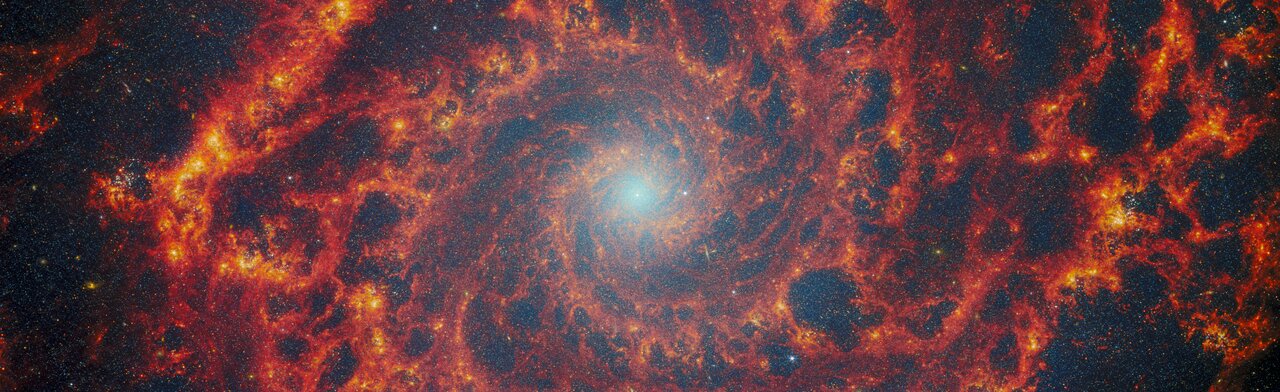
In August 2022, to mark the launch of the Picture of the Month series, ESA/Webb published a stunning image of the Phantom Galaxy (also known as M74 and NGC 628). Now, this series is revisiting the target to feature new data on this iconic spiral galaxy.
M74 resides around 32 million light-years away from Earth in the constellation Pisces, and lies almost face-on to Earth. This, coupled with its well-defined spiral arms, makes it a favourite target for astronomers studying the origin and structure of galactic spirals.
This image features data from two of Webb’s instruments: MIRI (Mid-InfraRed Instrument) and NIRCam (Near-InfraRed Camera). Observations in the infrared reveal the galaxy’s creeping tendrils of gas, dust and stars. In this image the dark red regions trace the filamentary warm dust permeating the galaxy. The red regions show the reprocessed light from complex molecules forming on dust grains, while orange and yellow colours reveal the regions of gas ionised by the recently formed star clusters. Stellar feedback has a dramatic effect on the medium within the galaxy and creates a complex network of bright knots as well as cavernous black bubbles. The lack of gas in the nuclear region of this galaxy also provides an unobscured view of the nuclear star cluster at the galaxy's centre. M74 is a particular class of spiral galaxy known as a ‘grand design spiral’, meaning that its spiral arms are prominent and well-defined, unlike the patchy and ragged structure seen in some spiral galaxies.
M74 was observed by Webb as part of a series of observations collectively entitled Feedback in Emerging extrAgalactic Star clusTers, or FEAST (PI: A. Adamo). Many other targets of the FEAST programme, including NGC 4449, M51, and M83, were the subjects of previous ESA/Webb Picture of the Month images in 2023 and 2024. The FEAST observations were designed to shed light on the interplay between stellar feedback and star formation in environments outside the Milky Way galaxy. Stellar feedback is the term used to describe the outpouring of energy from stars into the environments which form them, and is a process that contributes significantly to determining the rates at which stars form. Understanding stellar feedback is vital for building accurate universal models of star formation.
The new Webb data obtained by the FEAST team has allowed scientists to look at the stellar nurseries in galaxies that are many light years away. Astronomers are learning how other galaxies are forming stars and how stars actively participate to model the galaxy interstellar medium. They have found that newly born stars slowly carve they gas and dust nurseries modifying the morphological appearance and essentially destructing them, as Webb has shown that this evolution is connected with star clusters. Furthermore, the team has concluded from their studies that the spiral arms captured by the extended coverage of the FEAST programme are the places where stars are forming more actively in the galaxy. The brighter and larger complexes of stellar nurseries are in the spiral arms fully captured by the new Webb data. The telescope is now revealing the map of hydrogen emission lines in the near-infrared. These lines are less affected than the dusts and reveals the places where new massive stars have just formed.
From ESA/Webb Picture of the Month. ESA/Webb, NASA & CSA, A. Adamo (Stockholm University) and the FEAST JWST team, CC BY 4.0; links removed.


