ESA/Hubble Picture of the Month · September 8, 2025
Cloudy cluster
Where it is in your sky
- Object
- LMC N44C
- In the same part of the sky as NGC 1763
- Constellation
- Dorado
- Distance
- 160000 light years
- Field of view
- 2.2′ (the full Moon is 31′)
- Best seen
- Evenings from October to February; highest at midnight in December
- Climbs above 20°
- From the South Pole to 4° N
- Never rises
- North of 24° N
- What you need
- Beyond backyard telescopes — this is a Webb/Hubble-class target
- NGC 1763 itself: a small telescope (80–150 mm)
Tonight from your location
From the source
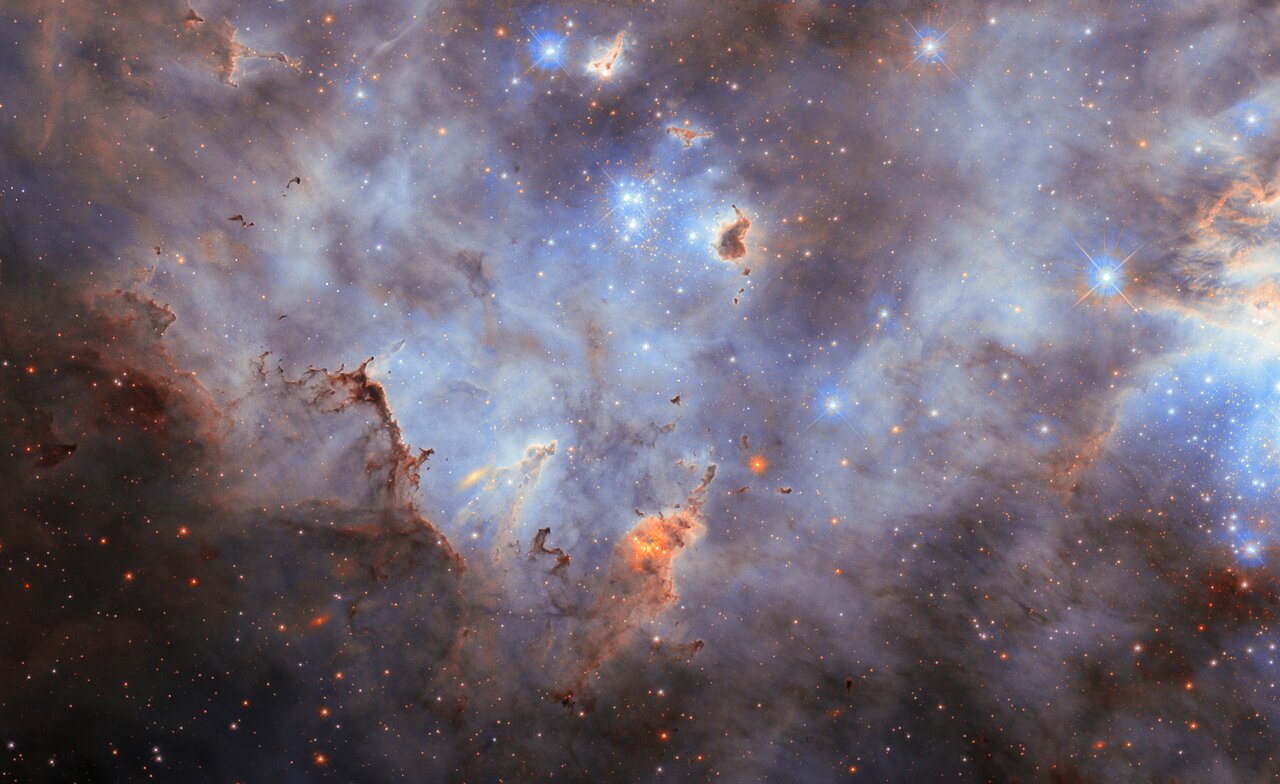
This new NASA/ESA Hubble Space Telescope Picture of the Week features a cloudy starscape from an impressive star cluster. This scene is located in the Large Magellanic Cloud, a dwarf galaxy situated about 160 000 light-years away in the constellations Dorado and Mensa. With a mass equal to 10–20% of the mass of the Milky Way, the Large Magellanic Cloud is the largest of the dozens of small galaxies that orbit our galaxy.
The Large Magellanic Cloud is home to several massive stellar nurseries where gas clouds, like those strewn across this image, coalesce into new stars. Today’s image depicts a portion of the galaxy’s second-largest star-forming region, which is called N11. (The most massive and prolific star-forming region in the Large Magellanic Cloud, the Tarantula Nebula, is a frequent target for Hubble.) We see bright, young stars lighting up the gas clouds and sculpting clumps of dust with powerful ultraviolet radiation.
This image marries observations made roughly 20 years apart, a testament to Hubble’s longevity. The first set of observations, which were carried out in 2002–2003, capitalised on the exquisite sensitivity and resolution of the then-newly-installed Advanced Camera for Surveys. Astronomers turned Hubble toward the N11 star cluster to do something that had never been done before at the time: catalogue all the stars in a young cluster with masses between 10% of the Sun’s mass and 100 times the Sun’s mass.
The second set of observations came from Hubble’s newest camera, the Wide Field Camera 3. These images focused on the dusty clouds that suffuse the cluster, bringing a new perspective on cosmic dust.
From ESA/Hubble Picture of the Month. ESA/Hubble & NASA, C. Murray, J. Maíz Apellániz, CC BY 4.0; links removed.


