ESA/Hubble Picture of the Month · October 6, 2025
Starbursting centre
Where it is in your sky
- Object
- NGC 6951 · Galaxy
- Constellation
- Cepheus
- Distance
- 70 million light years
- Field of view
- 3.0′ (the full Moon is 31′)
- Best seen
- Evenings from June to October; highest at midnight in July
- Climbs above 20°
- From 4° S to the North Pole
- Never rises
- South of 24° S
- What you need
- A larger telescope (200 mm+) and dark skies
Tonight from your location
From the source
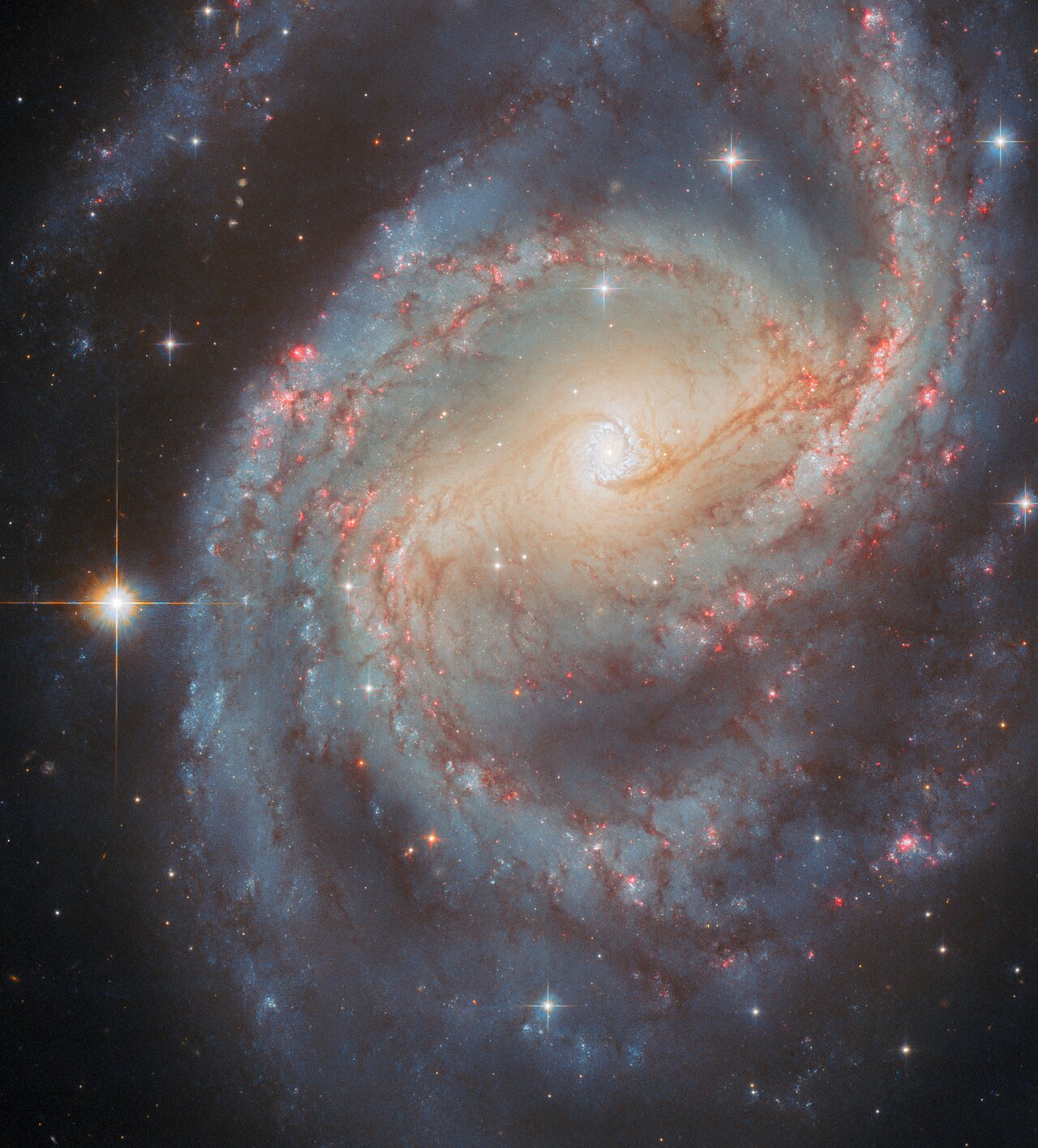
The glittering galaxy in this NASA/ESA Hubble Space Telescope Picture of the Week is NGC 6951, which resides about 70 million light-years away in the constellation Cepheus.
As this Hubble image shows, NGC 6951 is a spiral galaxy with plenty of intriguing structures. Most eye-catching are its spiral arms, which are dotted with brilliant red nebulae, bright blue stars and filamentary dust clouds. The spiral arms loop around the galactic centre, which has a golden glow that comes from a population of older stars. The centre of the galaxy is also distinctly elongated, revealing the presence of a slowly rotating bar of stars.
NGC 6951’s bar may be responsible for another remarkable feature: a white-blue ring that encloses the very heart of the galaxy. This is called a circumnuclear starburst ring — essentially, a circle of enhanced star formation around the nucleus of a galaxy. The bar funnels gas toward the centre of the galaxy, where it collects in a ring about 3800 light-years across. Two dark dust lanes that run parallel to the bar mark the points where gas from the bar enters the ring.
The dense gas of a circumnuclear starburst ring is the perfect environment to churn out an impressive number of stars. Using data from Hubble, astronomers have identified more than 80 potential star clusters within NGC 6951’s ring. Many of the stars formed less than 100 million years ago, but the ring itself is longer-lived, potentially having existed for 1–1.5 billion years.
Astronomers have imaged NGC 6951 with Hubble for a wide variety of reasons, including mapping the dust in nearby galaxies, studying the centres of disc galaxies and keeping tabs on recent supernovae (of which NGC 6951 has hosted five or six).
From ESA/Hubble Picture of the Month. ESA/Hubble & NASA, L. C. Ho, G. Brammer, A. Filippenko, C. Kilpatrick, CC BY 4.0; links removed.


