ESA/Hubble Picture of the Month · November 3, 2025
Revisiting an unusual spiral
Where it is in your sky
- Object
- NGC 4102 · Galaxy
- Constellation
- Ursa Major
- Distance
- 56 million light years
- Field of view
- 2.6′ (the full Moon is 31′)
- Best seen
- Evenings from January to May; highest at midnight in March
- Climbs above 20°
- From 17° S to the North Pole
- Never rises
- South of 37° S
- What you need
- A larger telescope (200 mm+) and dark skies
Tonight from your location
From the source
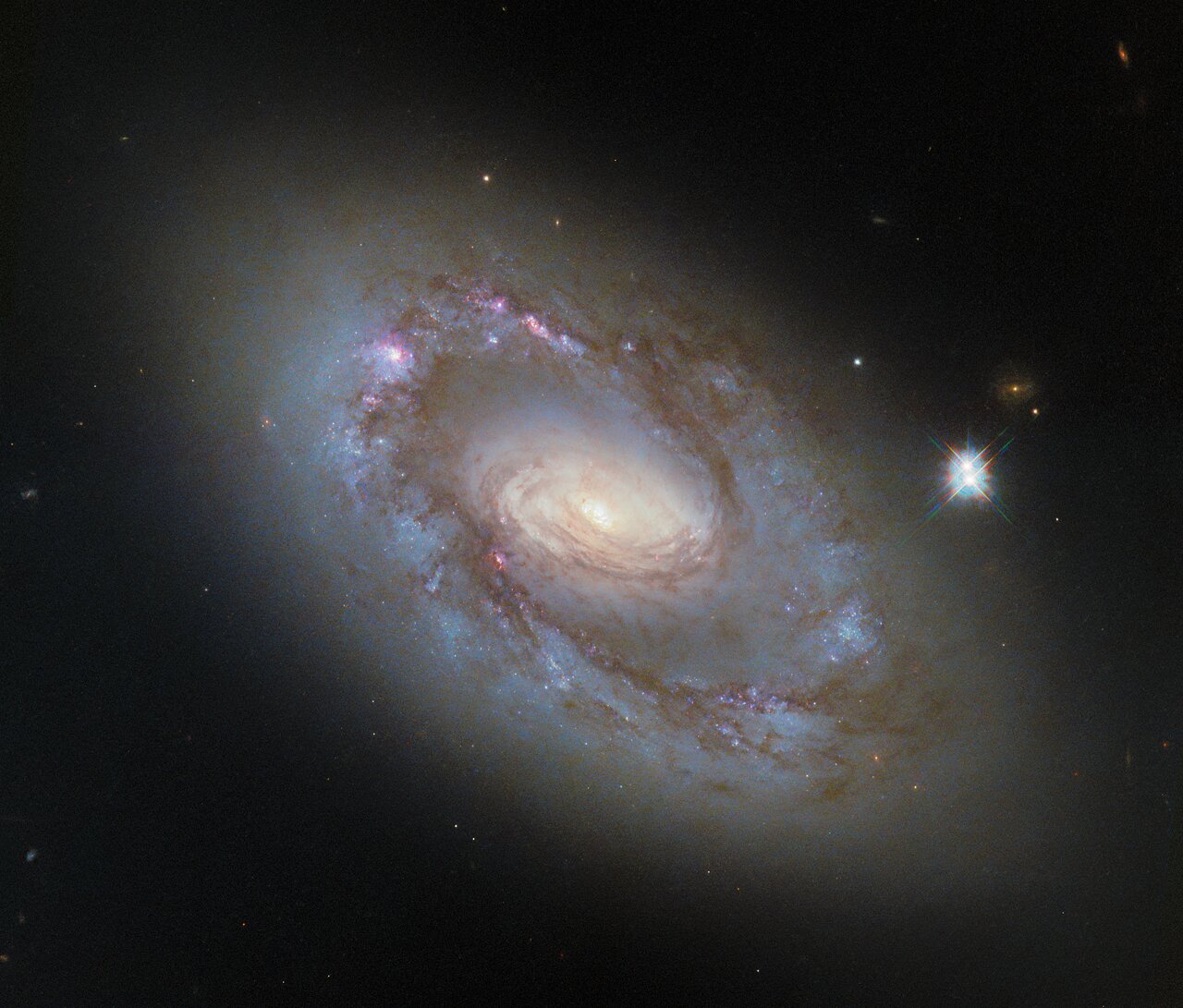
What lies at the heart of this unusual-looking spiral galaxy? The galaxy NGC 4102, featured in this ESA/Hubble Picture of the Week, is home to what astronomers call an active galactic nucleus. Active galactic nuclei are luminous galactic centres powered by supermassive black holes that contain millions to billion times the mass of our Sun. As these black holes ensnare gas from their surroundings and draw it close with their intense gravitational pull, the gas becomes so hot that it begins to glow and emits light from X-ray to radio wavelengths.
At a distance of just 56 million light-years away in the constellation Ursa Major (The Great Bear), NGC 4102 provides an ideal opportunity to study the ways in which active galactic nuclei interact with their home galaxies. Active galactic nuclei come in many different flavours, from extremely powerful types that consume massive amounts of matter and shoot out jets of charged particles, to calmer types that sip gas from their surroundings and glow more faintly.
NGC 4102 likely falls into the latter category. It’s classified as Compton-thick — a way of saying that its nucleus is obscured by a thick layer of gas — and a LINER, or low-ionisation nuclear emission-line region. LINER galaxies are identified by emission lines from certain weakly ionised elements, and they can be powered by a supermassive black hole that is lazily collecting gas from around it.
A previous image of this galaxy, made from data taken with Hubble’s Wide Field Planetary Camera 2 (WFPC2), was released in 2014. This new version presents an upgraded view of the galaxy, using data from the Wide Field Camera 3, which replaced WFPC2 in 2009 and improved upon its resolution and field of view. The new observations come from a programme that will combine visible-light images from Hubble with X-ray information from the Chandra X-ray Observatory to study the relationship between NGC 4102 and its active galactic nucleus.
From ESA/Hubble Picture of the Month. ESA/Hubble & NASA, G. Fabbiano, CC BY 4.0; links removed.


