ESA/Webb Picture of the Month · January 22, 2026
A celebrity cluster in the spotlight
Where it is in your sky
- Object
- MACS J1149.5+2223
- Constellation
- Leo
- Distance
- 5 billion light years
- Field of view
- 2.4′ (the full Moon is 31′)
- Best seen
- Evenings from January to May; highest at midnight in March
- Climbs above 20°
- From 48° S to the North Pole
- Never rises
- South of 68° S
- What you need
- Beyond backyard telescopes — this is a Webb/Hubble-class target
Tonight from your location
From the source
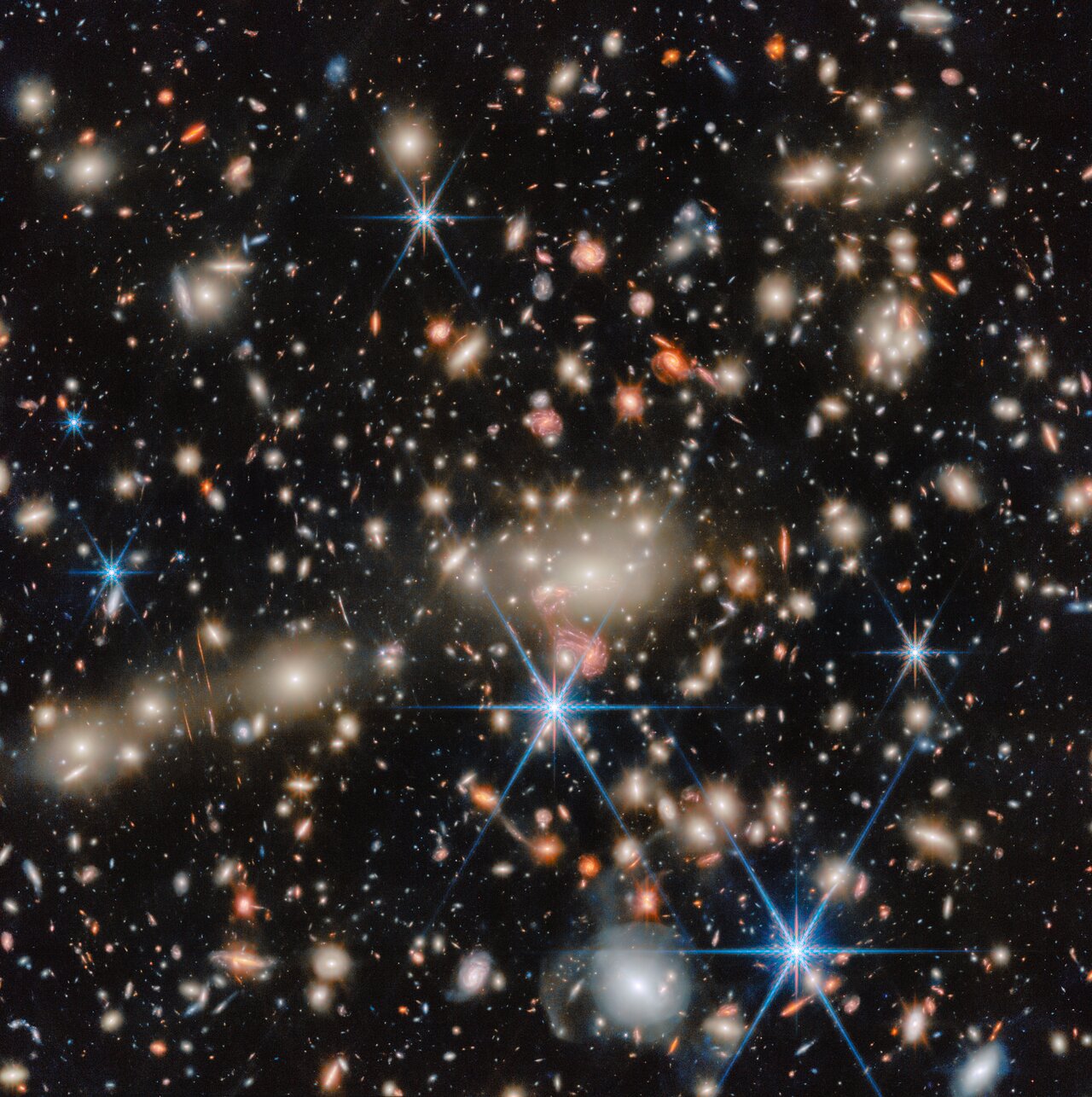
This NASA/ESA/CSA James Webb Space Telescope Picture of the Month brings us a scene from the distant Universe. Pictured here is the galaxy cluster MACS J1149.5+2223, or MACS J1149 for short, which is located about 5 billion light-years away in the constellation Leo.
Galaxy clusters are the largest structures in the Universe that are held together by gravity. Astronomers have confirmed more than 300 galaxies belonging to the MACS J1149 cluster, and they’ve identified several hundred more possible members. At the cluster’s centre, a huddle of ghostly elliptical galaxies rules over the cluster with their immense gravity.
The crushing gravity of this cluster does more than just hold all the galaxies together as they drift through space. As light from galaxies located behind the cluster makes its way toward our telescope, journeying for billions of years, its path through spacetime is bent by the mass of the intervening galaxies.
This phenomenon is called gravitational lensing, and the result is evident in this image of MACS J1149; scattered across the image are subtle and not-so-subtle examples of gravitational lensing, from galaxies that appear to have been stretched into narrow streaks of light to galaxy images that have morphed into strange shapes.
A fantastic example of gravitational lensing can be seen near the centre of the image, just below the brilliant white galaxies at the heart of the cluster. There, the image of a galaxy with distinct spiral arms has been stretched into something resembling a pink jellyfish. This tangled-looking galaxy is home to what was once the most distant single star ever discovered as well as a supernova whose image appeared four times at once.
MACS J1149 has long received the celebrity treatment from leading telescopes, and for good reason. This cluster was one of six investigated through the NASA/ESA Hubble Space Telescope’s Frontier Fields programme. The Frontier Fields galaxy clusters were selected for the strength of their gravitational lensing, and their ability to warp spacetime has granted researchers a glimpse into the early Universe.
Now, Webb is pushing our knowledge horizon to even earlier times, enabling new discoveries like a feasting supermassive black hole less than 600 million years after the Big Bang. Using Webb’s Near-Infrared Spectrograph (NIRSpec), Near-InfraRed Camera (NIRCam), and Near-InfraRed Imager and Slitless Spectrograph (NIRISS), researchers are revealing never-before-seen details of the lives of early galaxies.
The Webb data used to create this image were collected as part of the CAnadian NIRISS Unbiased Cluster Survey (CANUCS) programme #1208 (PI: C. J. Willott). This programme uses Webb’s sensitive instruments to unveil the evolution of low-mass galaxies in the early Universe, revealing their star formation, dust and chemistry. These data will also help researchers study the epoch of reionisation, when the first stars and galaxies lit up the Universe, map the distribution of mass within galaxy clusters, and understand how star formation can slow to a trickle in a cluster environment.
From ESA/Webb Picture of the Month. ESA/Webb, NASA & CSA, C. Willott (National Research Council Canada), R. Tripodi (INAF - Astronomical Observatory of Rome), CC BY 4.0; links removed.


