ESA/Hubble Picture of the Month · March 27, 2026
Where spiral arms and star formation meet
Where it is in your sky
- Object
- IC 486 · Galaxy
- Constellation
- Gemini
- Distance
- 380 million light years
- Field of view
- 2.3′ (the full Moon is 31′)
- Best seen
- Evenings from November to March; highest at midnight in January
- Climbs above 20°
- From 43° S to the North Pole
- Never rises
- South of 63° S
- What you need
- A larger telescope (200 mm+) and dark skies
Tonight from your location
From the source
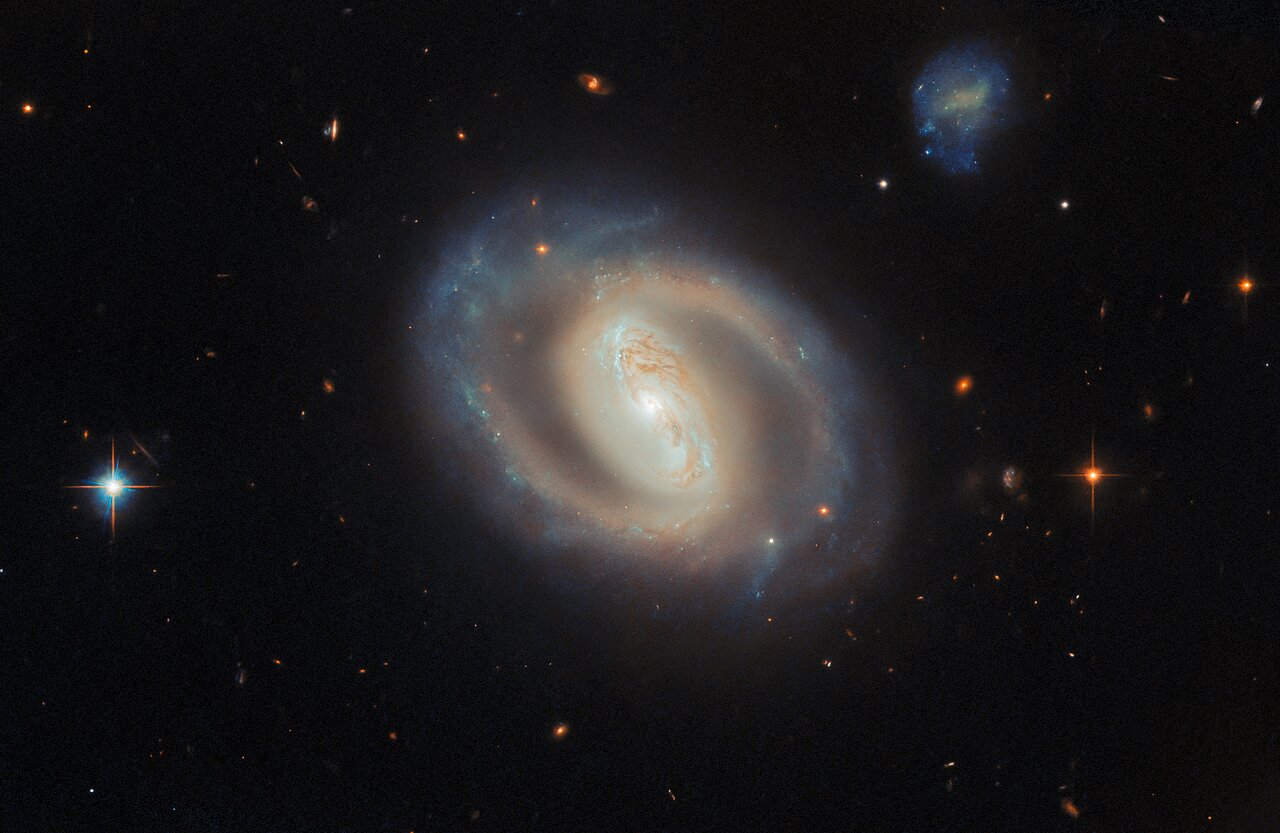
A luminous swirl set against the deep black of space, the barred spiral galaxy IC 486 glows with a soft, ethereal light in this new ESA/Hubble Picture of the Month image.
IC 486 lies right on the edge of the constellation Gemini (the Twins), around 380 million light-years from Earth. Classified as a barred spiral galaxy, it features a bright central bar-shaped structure from which its spiral arms unfurl, wrapping around the core in a smooth, almost ring-like pattern.
Hubble’s keen eye reveals subtle variations in colour across the galaxy. The pale, luminous centre is dominated by older stars, while faint bluish regions in the surrounding disc trace pockets of more recent star formation. Wisps of dust thread through the galaxy’s structure, gently obscuring light and tracing regions of increased molecular gas where new stars are likely to form.
At the galaxy’s centre a noticeable white glow outshines the starlight around it. This is light given off by IC 486’s active galactic nucleus (AGN), powered by a supermassive black hole more than 100 million times the mass of the Sun. Every sufficiently large galaxy hosts a supermassive black hole at its centre, but some of these black holes are particularly ravenous, marshalling vast amounts of gas and dust into swirling accretion discs from which they feed. The intense heat generated by the orbiting disc of material generates intense radiation up to and including X-rays, which can outshine the entire rest of the galaxy. In these cases, the galaxy is known as an active galaxy, with an AGN at its centre.
The data used to make this image comes from two separate observing programmes — #17310 (PI: M. J. Koss) and #15444 (PI: A. J. Barth) — with similar aims: to survey nearby active galaxies like IC 486 and record detailed, high-quality images of their central black holes and the stars near the core of the galaxy. By combining Hubble’s sharp imaging with large comprehensive samples, these programmes are enabling detailed comparisons of how stars, gas, dust, and black holes interact in galaxy centres.
A key goal of this work is to understand how galaxies grow by linking their large-scale structures, such as bars and spiral arms, to activity in their nuclei. To achieve this, the research teams are leveraging both expert classifications and citizen science through Galaxy Zoo, with datasets that will ultimately be released to the public. In parallel, the same images are being used to test how well large language models and other machine learning techniques can reproduce or extend human classifications, offering a new way to scale galaxy morphology studies to the largest surveys that are currently being performed with the Euclid telescope.
Beyond IC 486 itself, the image is peppered with distant background galaxies and foreground stars. Some stars appear with characteristic diffraction spikes, while the more diffuse, reddish smudges are far more distant galaxies scattered across the cosmos.
Though it may appear calm and orderly, IC 486 is a dynamic system shaped by gravity and stellar evolution. Over millions of years, its structure will continue to evolve as stars are born, age, and fade, contributing to the ongoing story of galactic life in the Universe.
From ESA/Hubble Picture of the Month. ESA/Hubble & NASA, M. J. Koss, A. J. Barth, CC BY 4.0; links removed.


