NASA News · July 31, 2026
APOD: 2026 July 31 – NGC 4372 and the Dark Doodad
Where it is in your sky
- Object
- NGC 4372 · Globular cluster
- Constellation
- Musca
- Best seen
- Evenings from January to May; highest at midnight in March
- Climbs above 20°
- From the South Pole to 3° S
- Never rises
- North of 17° N
- What you need
- A small telescope (80–150 mm)
Tonight from your location
From the source
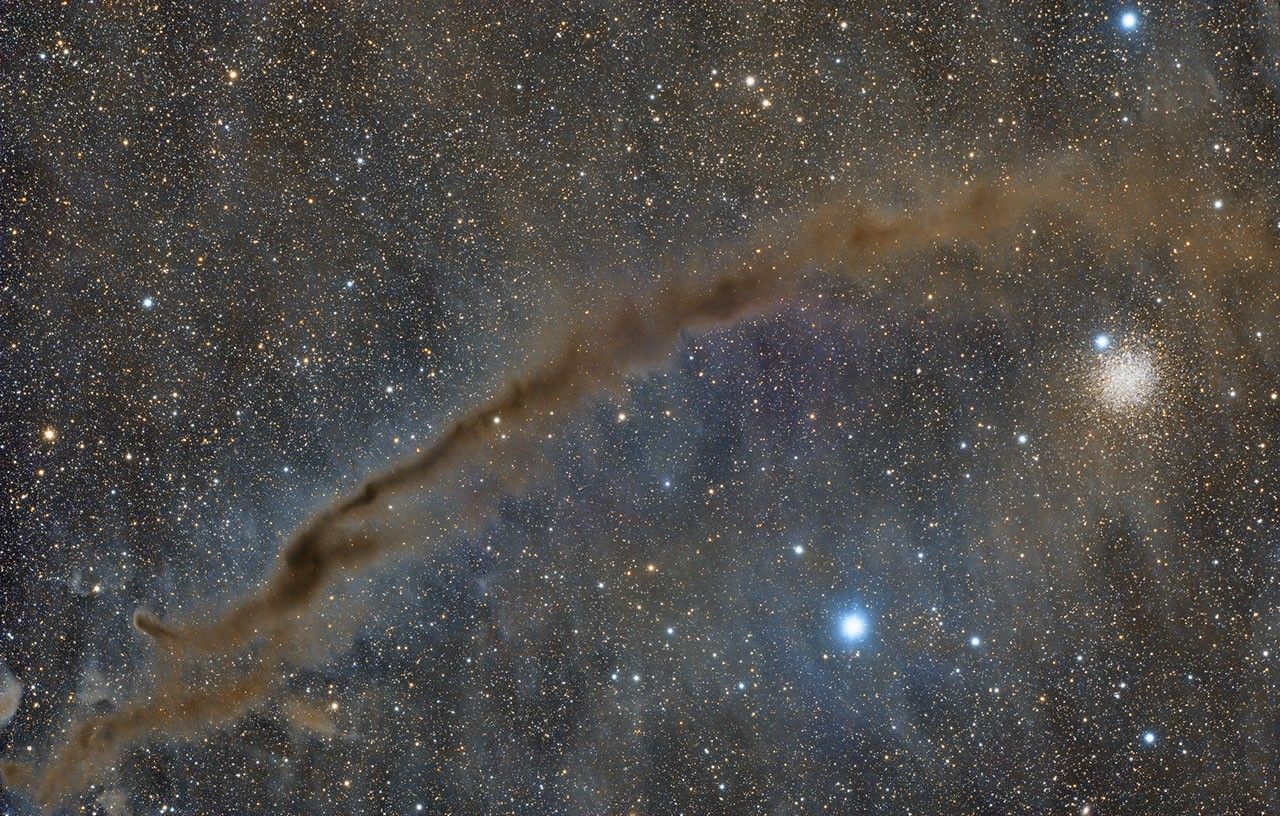
The Dark Doodad Nebula drifts through southern skies, a tantalizing target for binoculars toward the small constellation Musca, The Fly. A dusty interstellar cloud, it’s seen against rich starfields just south of the Coalsack Nebula and the Southern Cross. Stretching for about 3 degrees across this telescopic field of view, the Dark Doodad is punctuated near its southern tip (upper right) by yellowish globular star cluster NGC 4372. Of course NGC 4372 roams the halo of our Milky Way galaxy, a background object some 20,000 light-years away and only by chance along our line-of-sight to the Dark Doodad. About 700 light-years distant and over 30 light-years long, the Dark Doodad’s well defined silhouette belongs to the potentially star-forming Musca molecular cloud. The dusty Dark Doodad’s delightfully alliterative moniker was first coined by astro-imager and writer Dennis di Cicco in 1986 while observing Comet Halley from the Australian outback. Tomorrow’s picture: buck and belt
From NASA News.