ESA/Webb Picture of the Month · December 18, 2024
Close look at a local galaxy
Where it is in your sky
- Object
- NGC 2566 · Galaxy
- Constellation
- Puppis
- Distance
- 76 million light years
- Field of view
- 2.3′ (the full Moon is 31′)
- Best seen
- Evenings from November to March; highest at midnight in January
- Climbs above 20°
- From the South Pole to 45° N
- Never rises
- North of 65° N
- What you need
- A small telescope (80–150 mm)
Tonight from your location
From the source
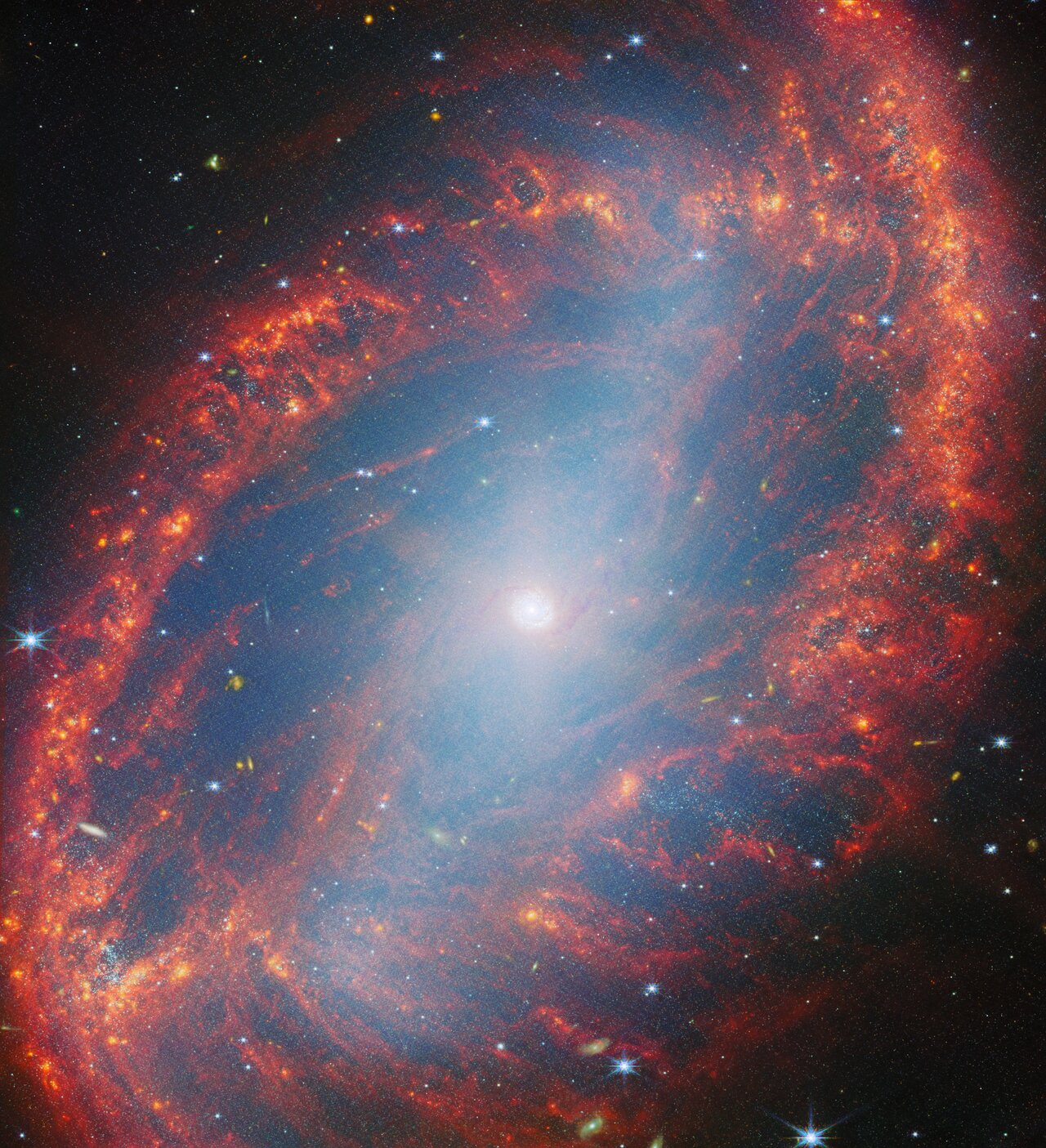
The galaxy filling the frame in this NASA/ESA/CSA James Webb Space Telescope Picture of the Month is NGC 2566, a spiral galaxy located in the constellation Puppis. The image combines observations from two of Webb’s instruments, the Near-InfraRed Camera (NIRCam) and Mid-InfraRed Instrument (MIRI), to show off NGC 2566’s well-defined spiral arms, long central bar and delicate tracery of gas, dust and stars.
At 76 million light-years away, NGC 2566 is considered a nearby galaxy, making it an excellent target for studying fine details like star clusters and gas clouds. The new Webb images of NGC 2566 were collected as part of an observing programme (#3707) dedicated to understanding the connections between stars, gas and dust in nearby star-forming galaxies. NGC 2566 is just one of the 55 galaxies in the local Universe examined by Webb for this programme.
The mid-infrared wavelengths captured by MIRI highlight NGC 2566’s warm interstellar dust, including complex, sooty molecules called polycyclic aromatic hydrocarbons. The near-infrared NIRCam data give a detailed view of the galaxy’s stars, even those that are deeply embedded within clouds of gas. The NIRCam data also capture some of the light from the hydrocarbon molecules.
To gain a full understanding of the star-formation process in nearby galaxies, astronomers will combine Webb data with observations from other telescopes. At the long-wavelength end of the electromagnetic spectrum, the 66 radio dishes of the Atacama Large Millimeter/submillimeter Array (ALMA) provide a detailed view of the cold, turbulent clouds where stars are born. The NASA/ESA Hubble Space Telescope has also cast its gaze on NGC 2566, and a new Hubble image of this galaxy was released earlier this week. The Hubble data will help researchers take a census of the stars in nearby galaxies, especially the young stars that are bright at the ultraviolet and visible wavelengths to which Hubble is sensitive. Together, the Webb, Hubble and ALMA data provide a rich view of the cold gas, warm dust and brilliant stars in NGC 2566.
The Webb data are part of a Treasury programme, which means that the data may help answer multiple important questions about our Universe. Treasury data are available for use by scientists and the public without a waiting period, amplifying the scientific impact and allowing exploration to begin immediately.
From ESA/Webb Picture of the Month. ESA/Webb, NASA & CSA, A. Leroy, CC BY 4.0; links removed.


