ESA/Webb Picture of the Month · February 4, 2025
Webb investigates a dusty and dynamic disc
Where it is in your sky
- Object
- HH 30
- In the same part of the sky as Caldwell 41 (Hyades)
- Constellation
- Taurus
- Distance
- 477 light years
- Field of view
- 0.2′ (the full Moon is 31′)
- Best seen
- Evenings from October to January; highest at midnight in December
- Climbs above 20°
- From 52° S to 88° N
- Never rises
- South of 72° S
- What you need
- Beyond backyard telescopes — this is a Webb/Hubble-class target
Tonight from your location
From the source
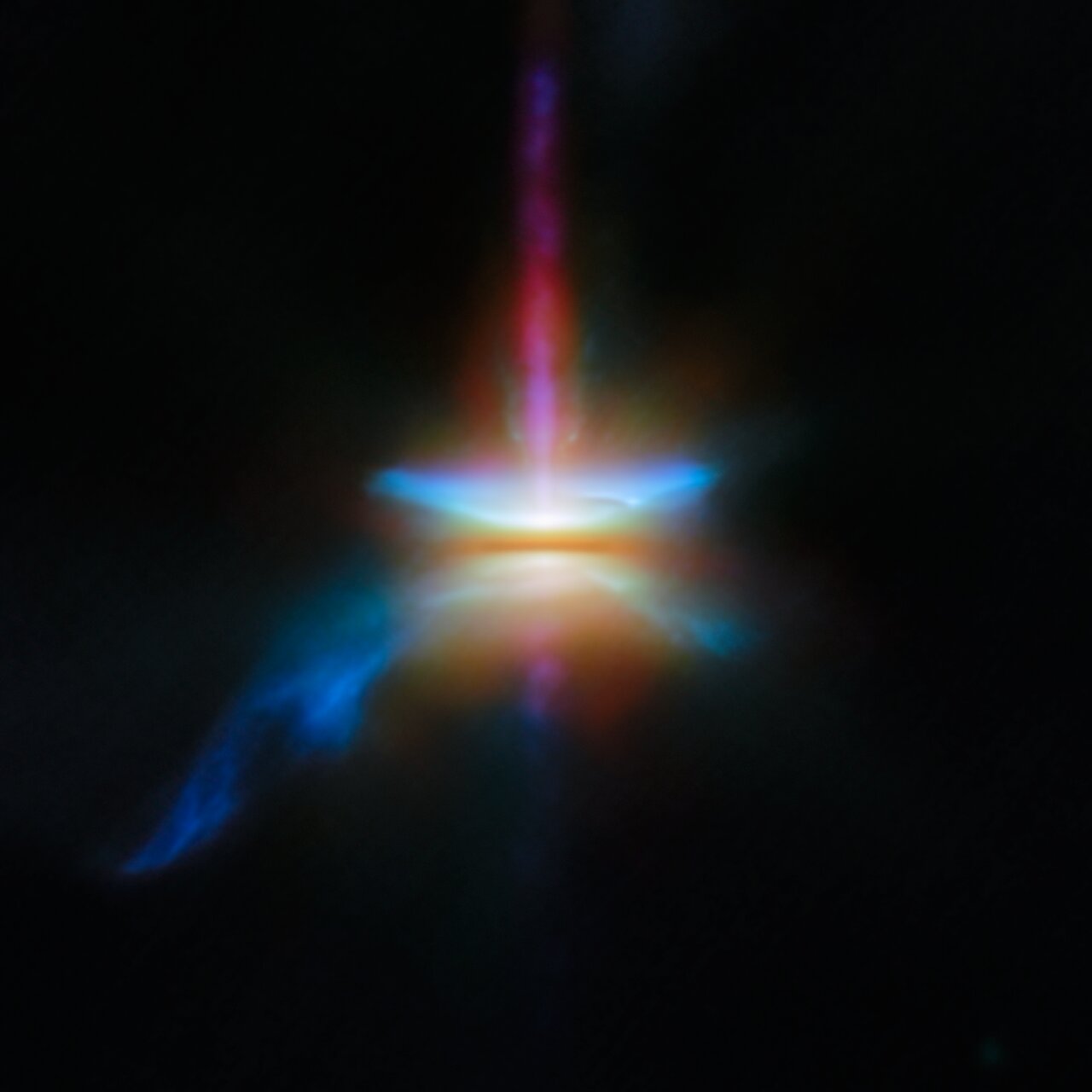
This new NASA/ESA/CSA James Webb Space Telescope Picture of the Month presents HH 30 in unprecedented resolution. This target is an edge-on protoplanetary disc that is surrounded by jets and a disc wind, and is located in the dark cloud LDN 1551 in the Taurus Molecular Cloud.
Herbig-Haro objects are small nebulae found in star formation regions, marking the locations where gas outflowing from young stars is heated into luminescence by shockwaves. HH 30 is an example of where this outflowing gas takes the form of a narrow jet. The source star is located on one end of the jet, hidden behind an edge-on protoplanetary disc that the star is illuminating.
HH 30 is of particular interest to astronomers. In fact, the HH 30 disc is considered the prototype of an edge-on disc, thanks to its early discovery with the NASA/ESA Hubble Space Telescope. Discs seen from this view are a unique laboratory to study the settling and drift of dust grains.
An international team of astronomers have used Webb to investigate the target in unprecedented detail. By combining Webb’s observations with those from the Hubble Space Telescope and the Atacama Large Millimeter/submillimeter Array (ALMA), the team was able to study the multiwavelength disc appearance of the system.
The long-wavelength data from ALMA trace the location of millimetre-sized dust grains, which are found in a narrow region in the central plane of the disc. The shorter-wavelength infrared data from Webb reveal the distribution of smaller dust grains. These grains are only one millionth of a metre across — about the size of a single bacterium. While the large dust grains are concentrated in the densest parts of the disc, the small grains are much more widespread.
These Webb observations were taken as part of the Webb GO programme #2562 (PI F. Ménard, K. Stapelfeldt), which aims to understand how dust evolves in edge-on discs like HH 30. Combined with the keen radio-wavelength eyes of ALMA, these observations show that large dust grains must migrate within the disc and settle in a thin layer. The creation of a narrow, dense layer of dust is an important stage in the process of planet formation. In this dense region, dust grains clump together to form pebbles and eventually planets themselves.
In addition to the behaviour of dust grains, the Webb, Hubble, and ALMA images reveal several distinct structures that are nested within one another. Emerging at a 90-degree angle from the narrow central disc is a high-velocity jet of gas. The narrow jet is surrounded by a wider, cone-shaped outflow. Enclosing the conical outflow is a wide nebula that reflects the light from the young star that is embedded within the disc. Together, these data reveal HH 30 to be a dynamic place, where tiny dust grains and massive jets alike play a role in the formation of new planets. The annotated verision of this image can be seen here.
From ESA/Webb Picture of the Month. ESA/Webb, NASA & CSA, Tazaki et al., CC BY 4.0; links removed.


