ESA/Webb Picture of the Month · February 28, 2025
Webb visits a star-forming spiral
Where it is in your sky
- Object
- NGC 2283 · Galaxy
- Constellation
- Canis Major
- Distance
- 45 million light years
- Field of view
- 2.2′ (the full Moon is 31′)
- Best seen
- Evenings from November to February; highest at midnight in January
- Climbs above 20°
- From 88° S to 52° N
- Never rises
- North of 72° N
- What you need
- A larger telescope (200 mm+) and dark skies
Tonight from your location
From the source
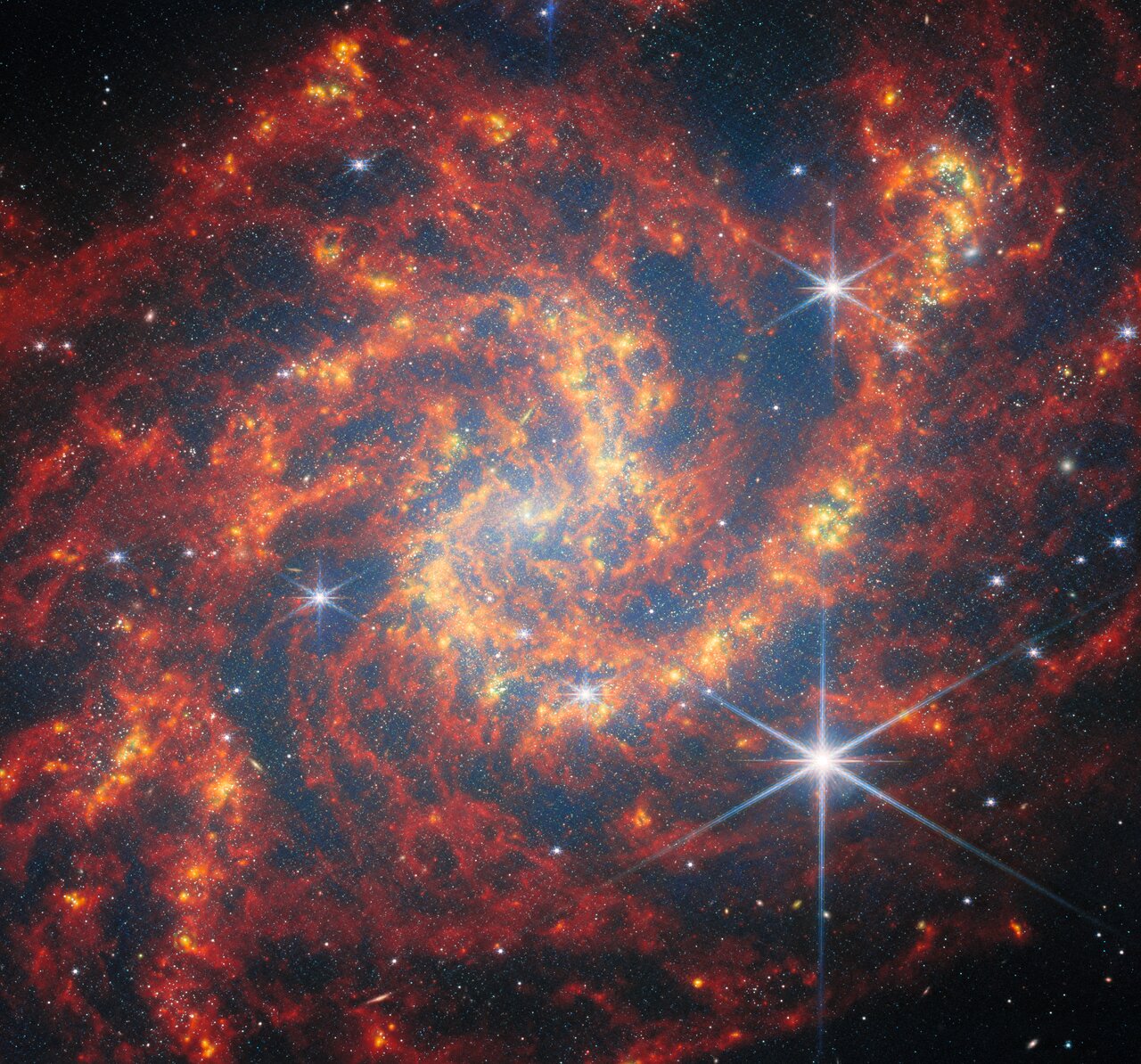
The target of today’s NASA/ESA/CSA James Webb Space Telescope Picture of the Month is the spiral galaxy NGC 2283. This galaxy resides roughly 45 million light-years away in the constellation Canis Major. Classified as a barred spiral galaxy, NGC 2283’s central bar of stars is encircled by loosely wound spiral arms.
This new image shows NGC 2283 through the eyes of Webb’s Near-InfraRed Camera (NIRCam) and Mid-InfraRed Instrument (MIRI). Webb gazed at NGC 2283 for a combined 17 minutes to collect the data for this image, which is constructed from six snapshots taken with different near- and mid-infrared filters. These filters reveal the emission from NGC 2283’s sparkling stellar population, as well as the light from clouds of hydrogen gas that have been heated by young stars. Sooty molecules called polycyclic aromatic hydrocarbons, of great interest to astronomers, emit light that’s mapped by two of the filters used here. The large, bright stars with prominent diffraction spikes on display in this image are inhabitants of our own galaxy, which lie between us and NGC 2283.
The new Webb images of NGC 2283 were collected as part of an observing programme (#3707) dedicated to understanding the connections between stars, gas and dust in nearby star-forming galaxies. NGC 2283 is just one of the 55 galaxies in the local Universe examined by Webb for this programme. All of the galaxies surveyed in this programme are massive star-forming galaxies close enough for individual star clusters and gas clouds to be visible.
These star clusters and gas clouds are on full display, outlining the galaxy’s graceful spiral arms. The dense knots of gas illuminated by young stars are evidence for active star formation that is turning cold hydrogen gas into blazing stars in NGC 2283.
Galaxies with active star formation often play host to spectacular stellar explosions called core-collapse supernovae. Just over two years ago, on 28 January 2023, a supernova named SN 2023AXU was discovered in NGC 2283. SN 2023AXU is what’s known as a Type II supernova — the collapse of the core of a star at least eight times as massive as the Sun and subsequent rebounding and explosion of the star’s outer layers.
While the process of star formation converts gas into new stars, supernovae complete the cycle. The explosion of a supernova can fling gas across hundreds of light-years, enriching the star-forming clouds of the interstellar medium with elements like oxygen and sodium. Over time, the supernova-enriched gas is incorporated into new generations of stars, continuing the life cycle of gas and stars in galaxies across the Universe.
From ESA/Webb Picture of the Month. ESA/Webb, NASA & CSA, A. Leroy, CC BY 4.0; links removed.


