ESA/Webb Picture of the Month · May 27, 2025
A glimpse of the distant past
Where it is in your sky
- Object
- Abell S1063
- Constellation
- Grus
- Distance
- 4 billion light years
- Field of view
- 2.3′ (the full Moon is 31′)
- Best seen
- Evenings from July to November; highest at midnight in September
- Climbs above 20°
- From the South Pole to 25° N
- Never rises
- North of 45° N
- What you need
- Beyond backyard telescopes — this is a Webb/Hubble-class target
Tonight from your location
From the source
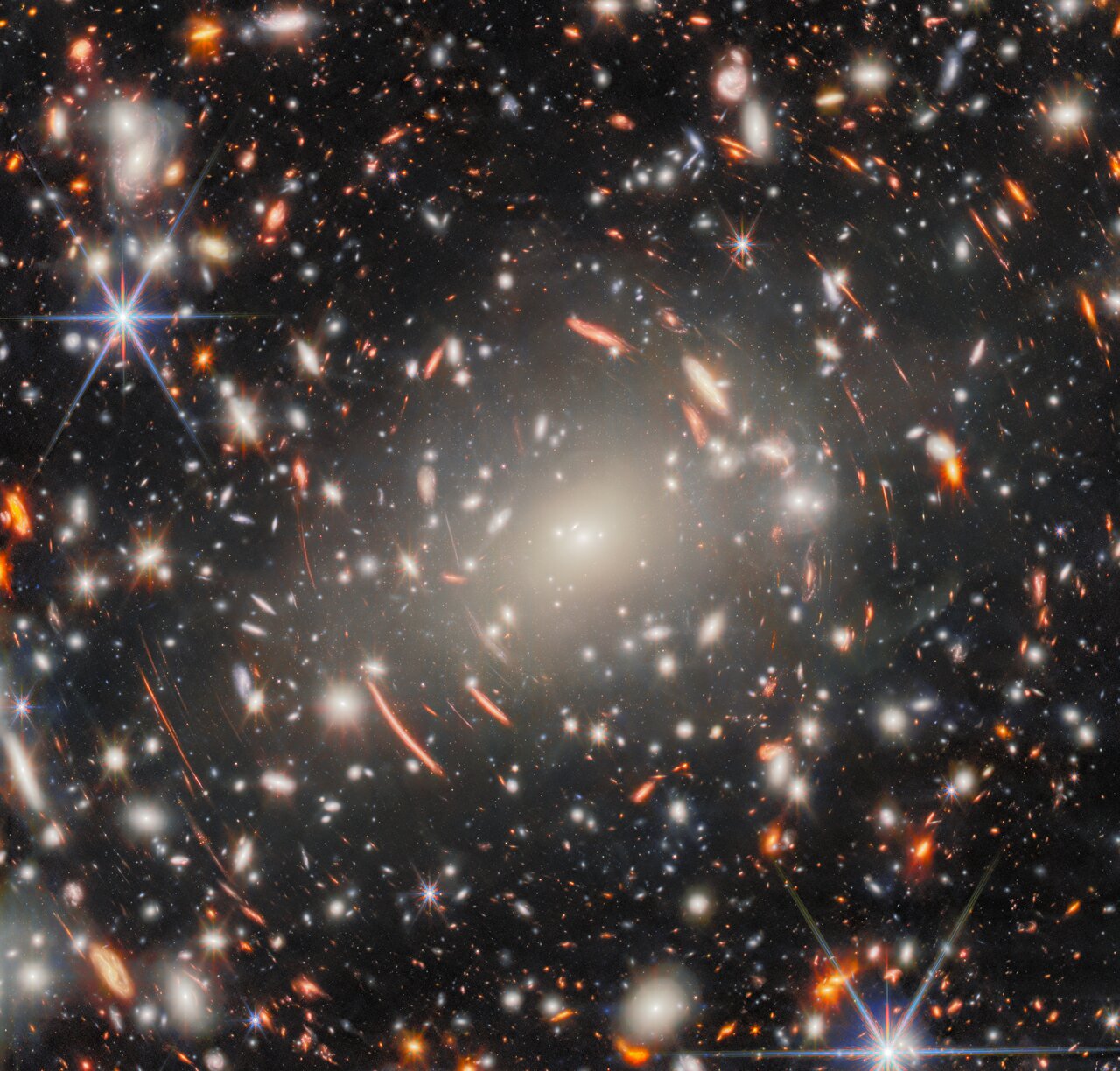
The eye is first drawn, in this new NASA/ESA/CSA James Webb Space Telescope Picture of the Month, to the central mega-monster that is galaxy cluster Abell S1063. This behemoth collection of galaxies, lying 4.5 billion light-years from Earth in the constellation Grus (the Crane), dominates the scene. Looking more closely, this dense collection of heavy galaxies is surrounded by glowing streaks of light, and these warped arcs are the true object of scientists’ interest: faint galaxies from the Universe’s distant past.
Abell S1063 was previously observed by the NASA/ESA Hubble Space Telescope’s Frontier Fields programme. It is a strong gravitational lens: the galaxy cluster is so massive that the light of distant galaxies aligned behind it is bent around it, creating the warped arcs that we see here. Like a glass lens, it focuses the light from these faraway galaxies. The resulting images, albeit distorted, are both bright and magnified — enough to be observed and studied. This was the aim of Hubble’s observations, using the galaxy cluster as a magnifying glass to investigate the early Universe.
The new imagery from Webb’s Near-Infrared Camera (NIRCam) takes this quest even further back in time. This image showcases an incredible forest of lensing arcs around Abell S1063, which reveal distorted background galaxies at a range of cosmic distances, along with a multitude of faint galaxies and previously unseen features.
This image is what’s known as a deep field — a long exposure of a single area of the sky, collecting as much light as possible to draw out the most faint and distant galaxies that don’t appear in ordinary images. With 9 separate snapshots of different near-infrared wavelengths of light, totalling around 120 hours of observing time and aided by the magnifying effect of gravitational lensing, this is Webb’s deepest gaze on a single target to date. Focusing such observing power on a massive gravitational lens, like Abell S1063, therefore has the potential to reveal some of the very first galaxies formed in the early Universe.
The observing programme that produced this data, GLIMPSE (#3293, PIs: H. Atek & J. Chisholm), aims to probe the period known as Cosmic Dawn, when the Universe was only a few million years old. Studying the galaxies revealed by gravitational lensing has the potential to develop our understanding of the emergence of the first galaxies. Analysis of this NIRCam data by the GLIMPSE team has already produced candidates for galaxies that existed as early as 200 million years after the Big Bang, and hints of the elusive first population of stars in the Universe.
From ESA/Webb Picture of the Month. ESA/Webb, NASA & CSA, H. Atek, M. Zamani (ESA/Webb) Acknowledgement: R. Endsley, CC BY 4.0; links removed.


