ESA/Webb Picture of the Month · June 30, 2025
A starburst shines in infrared
Where it is in your sky
- Object
- M 82 · Cigar Galaxy · Galaxy
- Constellation
- Ursa Major
- Distance
- 12 million light years
- Field of view
- 5.8′ (the full Moon is 31′)
- Best seen
- Evenings from December to April; highest at midnight in February
- Climbs above 20°
- From the equator to the North Pole
- Never rises
- South of 20° S
- What you need
- A small telescope (80–150 mm)
Tonight from your location
From the source
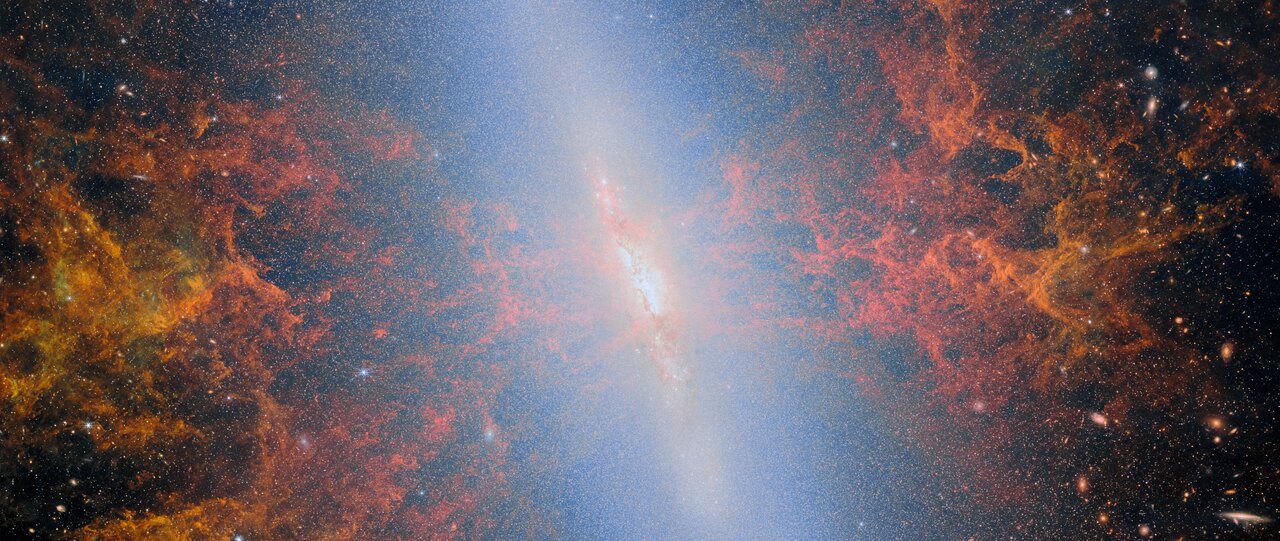
Featured in this NASA/ESA/CSA James Webb Space Telescope Picture of the Month is a nearby galaxy that outshines the Milky Way. This galaxy, called Messier 82 (M82) or the Cigar Galaxy, is situated just 12 million light-years away in the constellation Ursa Major.
Despite being smaller than the Milky Way, M82 is five times as luminous as our home galaxy and forms stars ten times faster. M82 is classified as a starburst galaxy because it is forming new stars at a rate much faster than expected for a galaxy of its mass, especially at its centre. In visible-light images of M82, the central hotbed of activity is obscured by a network of thick and dusty clouds. Webb’s Near-InfraRed Camera (NIRCam) has drawn back these clouds, revealing the full brilliance of the galactic centre.
What caused M82’s burst of star formation? The answer likely lies with its neighbour, the larger spiral galaxy M81. Researchers suspect that the two galaxies have interacted gravitationally, sending gas pouring into M82’s centre millions of years ago. The influx of gas provided the raw material for new stars to form — and form they did! M82 is home to more than 100 super star clusters, some of which are still in the process of forming and are blanketed with dense, dusty gas. Super star clusters are more massive and luminous than typical star clusters; these each contain hundreds of thousands of stars.
A previous Webb NIRCam image of M82 was released in 2024. The earlier image focused on the very core of the galaxy, where individual clusters of young stars stand out against the clumps and tendrils of gas. This new image takes a broader view of M82’s brilliant centre, capturing the light of billions of stars as well as the glow of organic molecules called polycyclic aromatic hydrocarbons, or PAHs.
Researchers used the new Webb data to identify plumes traced by the emission from PAH molecules. Each plume is only about 160 light-years wide, and the Webb images show that these plumes are made up of multiple individual clouds that are 16–49 light-years across — an incredible level of detail enabled by Webb’s sensitive instruments. These clouds appear to have been caught up in the galaxy’s powerful outflowing winds and whisked away from the galactic disc.
Ultimately, this phenomenon points back to the galaxy’s remarkable abundance of massive star clusters: as these massive clusters form, their newborn stars sear the surrounding gas with high-energy radiation and particles, launching the outflowing wind that is traced by this NIRCam image.
From ESA/Webb Picture of the Month. ESA/Webb, NASA & CSA, A. Bolatto, CC BY 4.0; links removed.


