ESA/Hubble Picture of the Month · July 14, 2025
Digging up a galactic time capsule
Where it is in your sky
- Object
- In the same part of the sky as Large Magellanic Cloud
- Constellation
- Dorado
- Distance
- 160000 light years
- Field of view
- 2.3′ (the full Moon is 31′)
- Best seen
- Evenings from October to February; highest at midnight in December
- Climbs above 20°
- From the South Pole to 2° N
- Never rises
- North of 22° N
- What you need
- Beyond backyard telescopes — this is a Webb/Hubble-class target
- Large Magellanic Cloud itself: naked eye, from a dark site
Tonight from your location
From the source
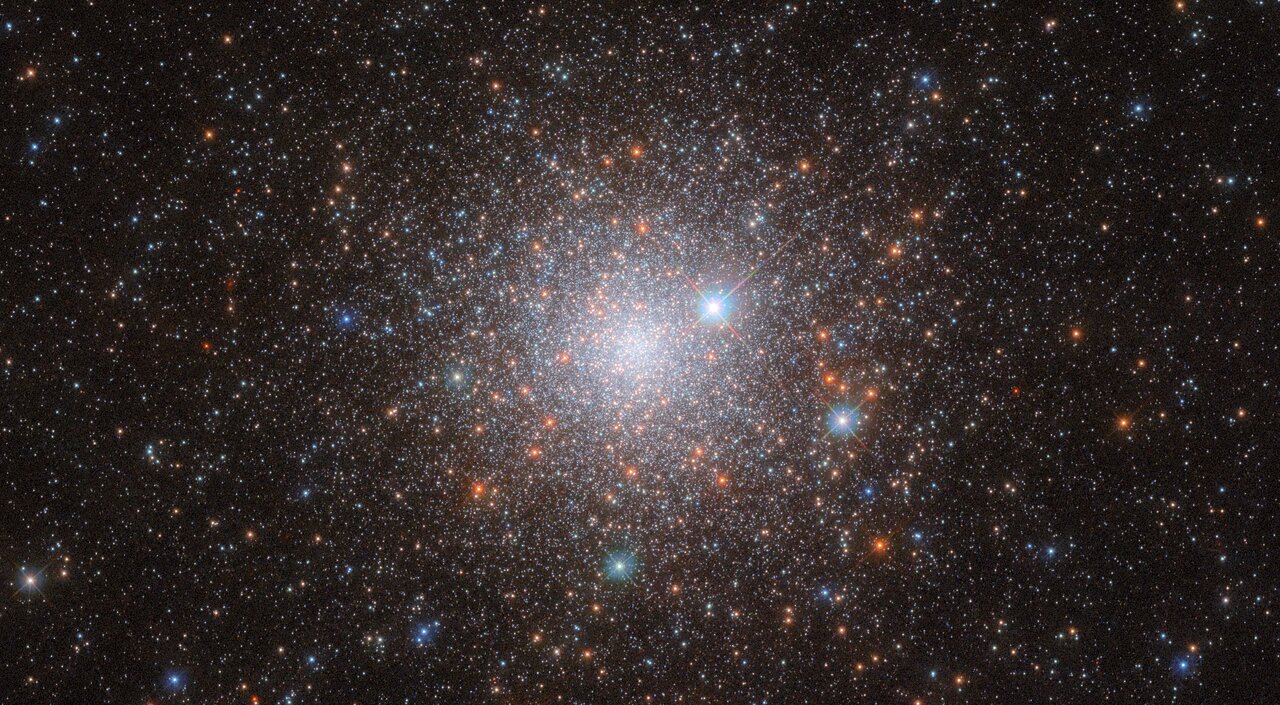
For this ESA/Hubble Picture of the Week, we gaze upon the field of stars that is NGC 1786. This object is a globular cluster in the Large Magellanic Cloud (LMC), a small satellite galaxy of the Milky Way Galaxy that is approximately 160 000 light-years away from Earth. NGC 1786 itself is in the constellation Dorado. It was discovered in the year 1835 by John Herschel.
The data for this image comes from an observing programme comparing old globular clusters in nearby dwarf galaxies — the LMC, the Small Magellanic Cloud and the Fornax dwarf spheroidal galaxy — to the globular clusters in the Milky Way galaxy. Our galaxy contains over 150 of these old, spherical collections of tightly-bound stars, which have been studied in depth — especially with Hubble Space Telescope images like this one, which show them in previously-unattainable detail. Being very stable and long-lived, they act as galactic time capsules, preserving stars from the earliest stages of a galaxy’s formation.
Astronomers once thought that the stars in a globular cluster all formed together at about the same time, but study of the old globular clusters in our galaxy has uncovered multiple populations of stars with different ages. In order to use globular clusters as historical markers, we must understand how they form and where these stars of varying ages come from. This observing programme examined old globular clusters like NGC 1786 in these external galaxies to see if they, too, contain multiple populations of stars. This research can tell us more not only about how the LMC was originally formed, but the Milky Way Galaxy, too.
From ESA/Hubble Picture of the Month. ESA/Hubble & NASA, M. Monelli Acknowledgement: M. H. Özsaraç, CC BY 4.0; links removed.


