ESA/Webb Picture of the Month · August 1, 2025
A fresh look at a classic deep field
Where it is in your sky
- Constellation
- Fornax
- Field of view
- 2.1′ (the full Moon is 31′)
- Best seen
- Evenings from September to January; highest at midnight in November
- Climbs above 20°
- From the South Pole to 42° N
- Never rises
- North of 62° N
- What you need
- Beyond backyard telescopes — this is a Webb/Hubble-class target
Tonight from your location
From the source
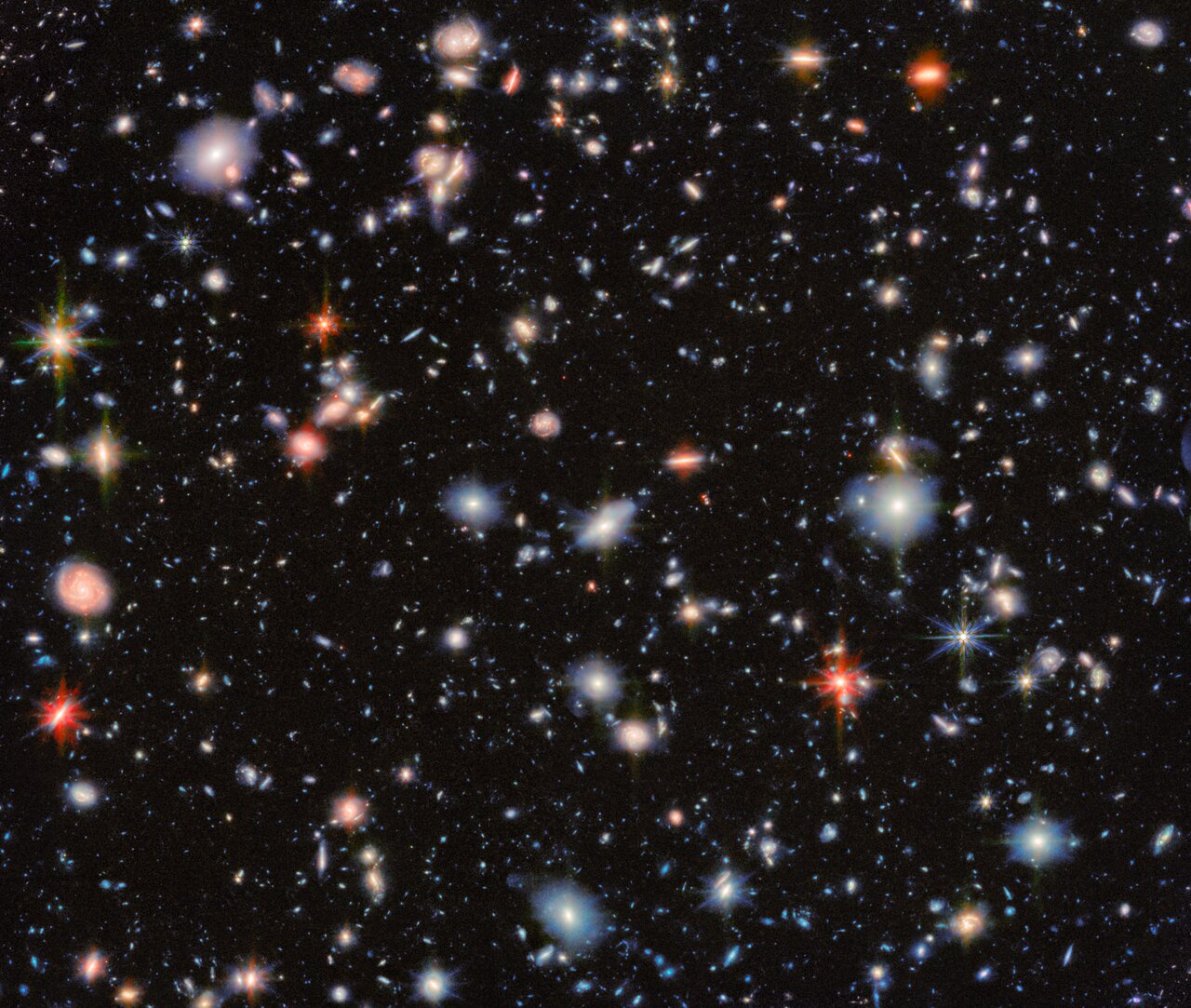
This image from the NASA/ESA/CSA James Webb Space Telescope revisits one of the most iconic regions of the sky, the Hubble Ultra Deep Field, through the eyes of two of Webb’s instruments. The result is a detailed view that reveals thousands of distant galaxies, some dating back to the earliest periods of cosmic history. The field shown here, known as the MIRI Deep Imaging Survey (MIDIS) region, was observed with the three shortest-wavelength filters of Webb’s Mid-Infrared Instrument (MIRI) for nearly 100 hours in total. This included Webb's longest observation of an extragalactic field in one filter so far, producing one of the deepest views ever obtained of the Universe. Combined with data from Webb’s Near-Infrared Camera (NIRCam), this image allows astronomers to explore how galaxies formed and evolved over billions of years.
These deep observations have revealed more than 2500 sources in this tiny patch of sky. Among them are hundreds of extremely red galaxies — some of which are likely massive, dust-obscured systems or evolved galaxies with mature stars that formed early in the Universe’s history. Thanks to Webb’s sharp resolution, even at mid-infrared wavelengths, researchers can resolve the structures of many of these galaxies and study how their light is distributed, shedding light on their growth and evolution.
In this image, the colours that have been assigned to different kinds of infrared light highlight the fine distinctions astronomers can make with this deep data. Orange and red represent the longest mid-infrared wavelengths. The galaxies in these colours have extra features — such as high concentrations of dust, copious star formation, or an active galactic nucleus (AGN) at their centre — which emit more of this farther infrared light. Small, greenish-white galaxies are particularly distant, with high redshift. This shifts their light spectrum into the peak mid-infrared wavelengths of the data, which are depicted in white and green. Most of the galaxies in this image lack any such mid-infrared boosting features, leaving them most bright at shorter near-infrared wavelengths, which are depicted with blue and cyan colours.
By returning to this legacy field first made famous by the NASA/ESA Hubble Space Telescope, Webb is continuing and expanding the deep field tradition — revealing new details, uncovering previously hidden galaxies, and offering fresh insights into the formation of the first cosmic structures.
The MIRI observations were taken as part of the Webb programmes #1283 and #6511 (PI: G. Östlin).
From ESA/Webb Picture of the Month. ESA/Webb, NASA & CSA, G. Östlin, P. G. Perez-Gonzalez, J. Melinder, the JADES Collaboration, the MIDIS collaboration, M. Zamani (ESA/Webb), CC BY 4.0; links removed.


