ESA/Hubble Picture of the Month · August 4, 2025
A sea monster and a Tarantula
Where it is in your sky
- Object
- In the same part of the sky as Large Magellanic Cloud
- Constellation
- Dorado
- Distance
- 160000 light years
- Field of view
- 3.5′ (the full Moon is 31′)
- Best seen
- Evenings from October to February; highest at midnight in December
- Climbs above 20°
- From the South Pole to 1° N
- Never rises
- North of 21° N
- What you need
- Beyond backyard telescopes — this is a Webb/Hubble-class target
- Large Magellanic Cloud itself: naked eye, from a dark site
Tonight from your location
From the source
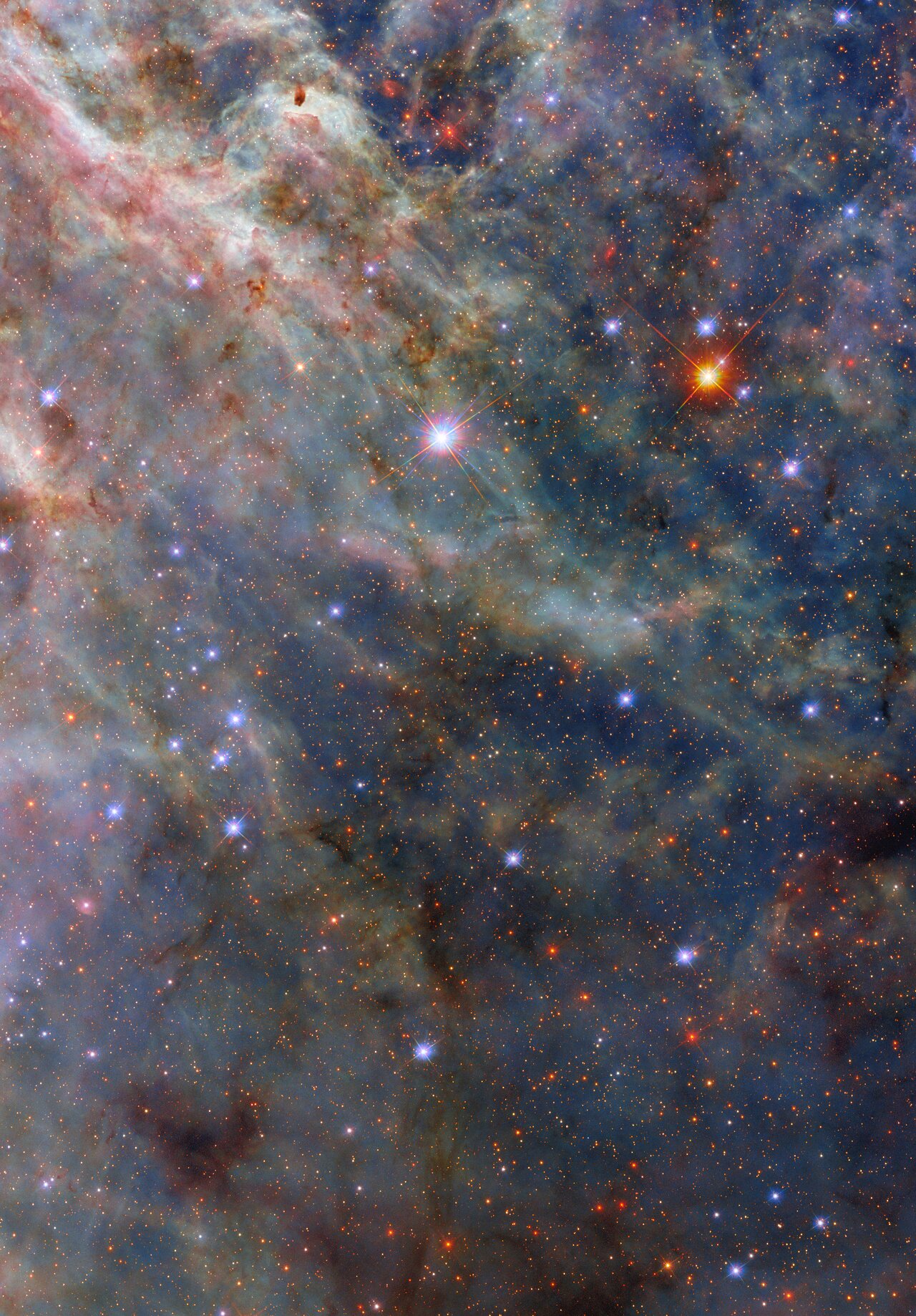
A scene from a star-forming factory shines in this NASA/ESA Hubble Space Telescope Picture of the Week. This Hubble picture captures incredible details in the dusty clouds in a star-forming region called the Tarantula Nebula. What’s possibly the most amazing aspect of this detailed image is that this nebula isn’t even in our galaxy. Instead, it’s in the Large Magellanic Cloud, a dwarf galaxy that is located about 160 000 light-years away in the constellations Dorado and Mensa.
The Large Magellanic Cloud is the largest of the dozens of small satellite galaxies that orbit the Milky Way. The Tarantula Nebula is the largest and brightest star-forming region not just in the Large Magellanic Cloud, but in the entire group of nearby galaxies to which the Milky Way belongs.
The Tarantula Nebula is home to the most massive stars known, some of which are roughly 200 times as massive as our Sun. The scene pictured here is located away from the centre of the nebula, where there is a super star cluster called R136, but very close to a rare type of star called a Wolf–Rayet star. Wolf–Rayet stars are massive stars that have lost their outer shell of hydrogen and are extremely hot and luminous, powering dense and furious stellar winds.
This nebula is a frequent target for Hubble, whose multiwavelength capabilities are critical for capturing sculptural details in the nebula’s dusty clouds. The data used to create this image come from an observing programme called Scylla, named for a multi-headed sea monster from the Greek myth of Ulysses. The Scylla programme was designed to complement another Hubble observing programme called ULLYSSES (Ultraviolet Legacy Library of Young Stars as Essential Standards). ULLYSSES targets massive young stars in the Small and Large Magellanic Clouds, while Scylla investigates the structures of gas and dust that surround these stars.
From ESA/Hubble Picture of the Month. ESA/Hubble & NASA, C. Murray, CC BY 4.0; links removed.


