ESA/Hubble Picture of the Month · August 18, 2025
Noteworthy nearby spiral
Where it is in your sky
- Object
- NGC 2835 · Galaxy
- Constellation
- Hydra
- Distance
- 35 million light years
- Field of view
- 2.7′ (the full Moon is 31′)
- Best seen
- Evenings from December to April; highest at midnight in February
- Climbs above 20°
- From the South Pole to 48° N
- Never rises
- North of 68° N
- What you need
- A small telescope (80–150 mm)
Tonight from your location
From the source
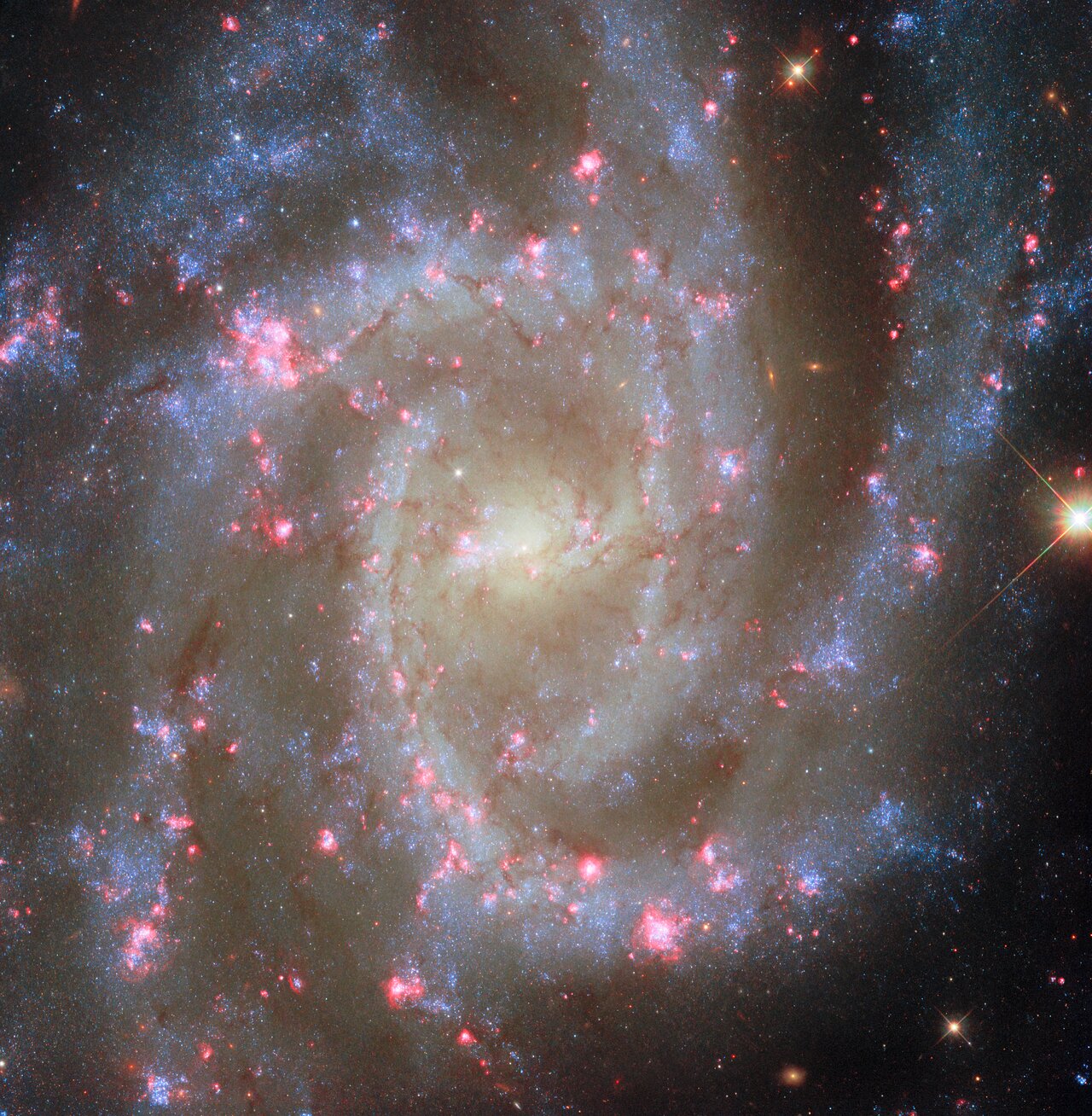
Today’s NASA/ESA Hubble Space Telescope Picture of the Week offers a closeup of a nearby spiral galaxy. The subject is NGC 2835, which lies 35 million light-years away in the constellation Hydra (The Water Snake).
A previous Hubble image of this galaxy was released in 2020, and the NASA/ESA/CSA James Webb Space Telescope turned its gaze toward NGC 2835 in recent years as well. Do you see anything different between today’s image of NGC 2835 and the previously released versions? Overall, NGC 2835 looks quite similar in all of these images, with spiral arms dotted with young blue stars sweeping around an oval-shaped centre, where older stars reside.
This image differs from previously released images because it incorporates new data from Hubble that captures a specific wavelength of red light called H-alpha. The regions that are bright in H-alpha emission can be seen along NGC 2835’s spiral arms, where dozens of bright pink nebulae appear like flowers in bloom. Astronomers are interested in H-alpha light because it signals the presence of several different types of nebulae that arise during different stages of a star’s life. Newborn massive stars create nebulae called H II regions that are particularly brilliant sources of H-alpha light, while dying stars can leave behind supernova remnants or planetary nebulae that can also be identified by their H-alpha emission.
By using Hubble’s sensitive instruments to survey 19 nearby galaxies, researchers aim to identify more than 50 000 nebulae. These observations will help to explain how stars affect their birth neighbourhoods through intense starlight and winds.
From ESA/Hubble Picture of the Month. ESA/Hubble & NASA, R. Chandar, J. Lee and the PHANGS-HST team, CC BY 4.0; links removed.


