ESA/Hubble Picture of the Month · August 11, 2025
Low brightness, high interest
Where it is in your sky
- Object
- NGC 45 · Galaxy
- Constellation
- Cetus
- Distance
- 22 million light years
- Field of view
- 2.6′ (the full Moon is 31′)
- Best seen
- Evenings from July to November; highest at midnight in September
- Climbs above 20°
- From the South Pole to 47° N
- Never rises
- North of 67° N
- What you need
- A small telescope (80–150 mm)
Tonight from your location
From the source
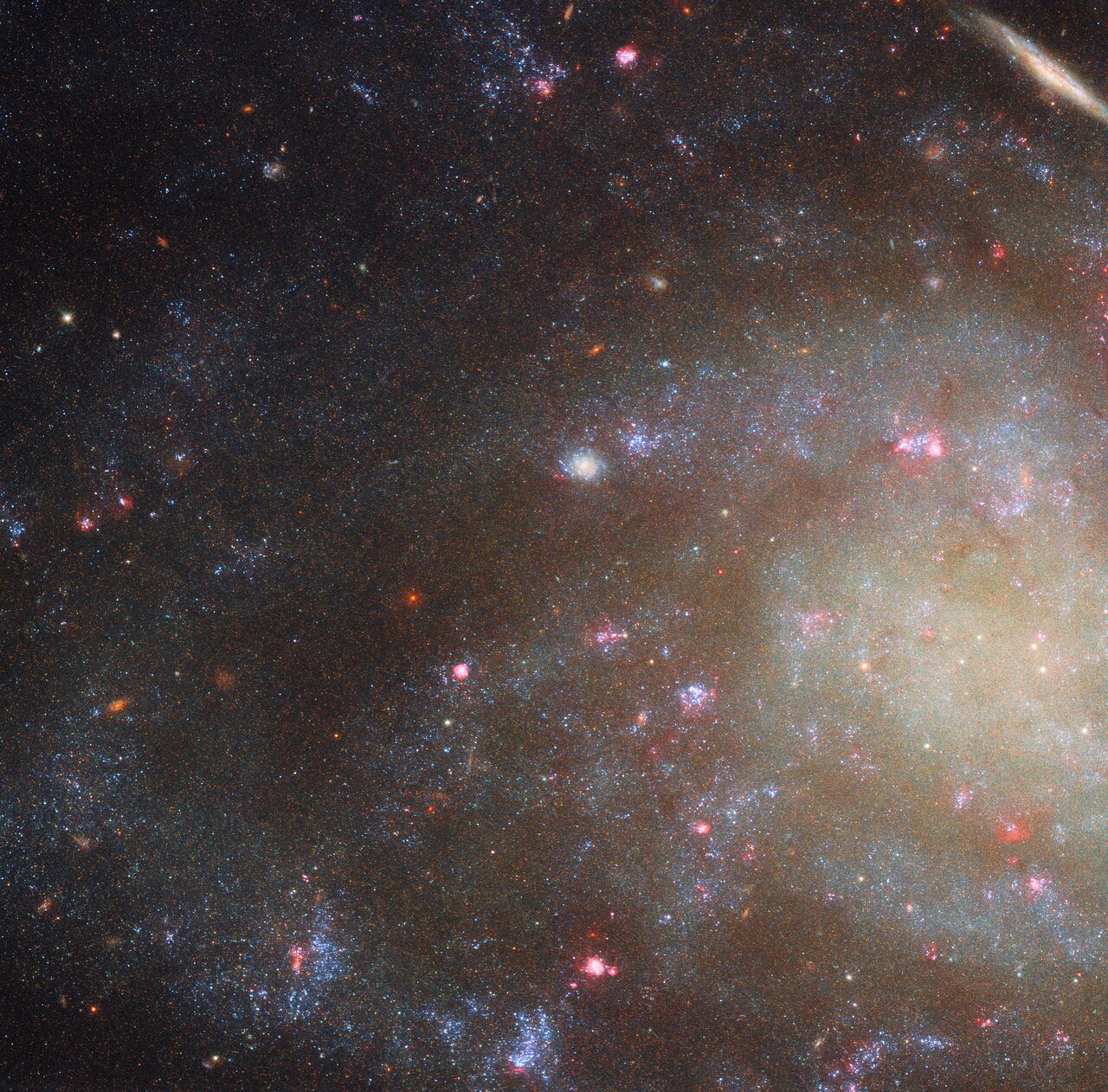
This NASA/ESA Hubble Space Telescope Picture of the Week zooms in on the feathery spiral arms of the galaxy NGC 45, which lies just 22 million light-years away in the constellation Cetus (The Whale).
The data used to create this portrait were drawn from two complementary observing programmes. The first took a broad view of 50 nearby galaxies, leveraging Hubble’s ability to observe light from the ultraviolet to the near-infrared in order to study star formation in these galaxies. The second programme examined many of the same nearby galaxies as the first, narrowing in on a particular wavelength of red light called H-alpha. Star-forming nebulae are powerful producers of H-alpha light, and several of these regions can be identified across NGC 45 by their bright pink-red colour.
These observing programmes aimed to study star formation in galaxies of different sizes, structures, and degrees of isolation — and NGC 45 makes for a particularly interesting target. Though it may appear to be a regular spiral galaxy, NGC 45 is actually a remarkable type called a low surface brightness galaxy.
Low surface brightness galaxies are fainter than the night sky itself, making them incredibly difficult to detect. They appear unexpectedly faint because they have relatively few stars for the amount of gas and dark matter they carry. In the decades since the first low surface brightness galaxy was serendipitously discovered in 1986, researchers have learned that 30–60% of all galaxies may fall into this category. Studying these hard-to-detect galaxies is key to understanding how galaxies form and evolve, and Hubble’s sensitive instruments are equal to the task.
From ESA/Hubble Picture of the Month. ESA/Hubble & NASA, D. Calzetti, R. Chandar Acknowledgement: M. H. Özsaraç, CC BY 4.0; links removed.


