ESA/Hubble Picture of the Month · September 29, 2025
Yellow and blue, old and new
Where it is in your sky
- Object
- NGC 6000 · Galaxy
- Constellation
- Scorpius
- Distance
- 102 million light years
- Field of view
- 2.4′ (the full Moon is 31′)
- Best seen
- Evenings from March to July; highest at midnight in May
- Climbs above 20°
- From the South Pole to 41° N
- Never rises
- North of 61° N
- What you need
- A larger telescope (200 mm+) and dark skies
Tonight from your location
From the source
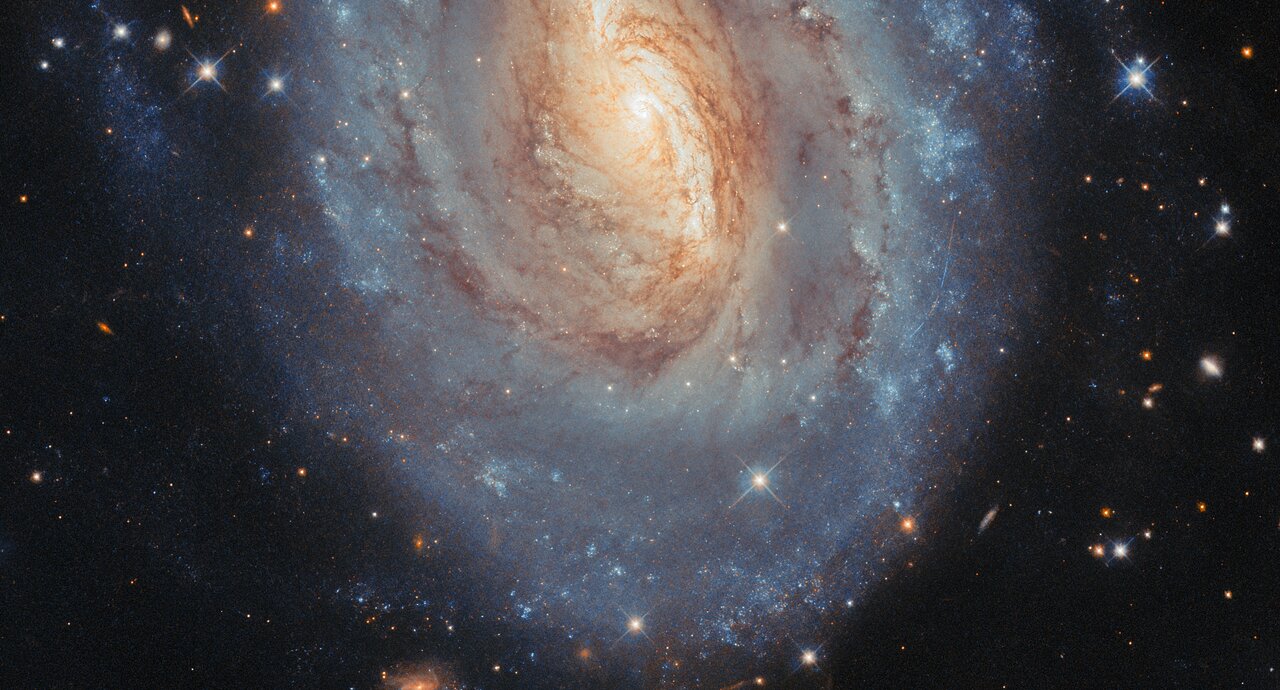
Stars of all ages are on display in today’s NASA/ESA Hubble Space Telescope Picture of the Week. This sparkling spiral galaxy is called NGC 6000 and it is located 102 million light-years away in the constellation Scorpius.
This galaxy has a glowing yellow centre and glittering blue outskirts. The colours reflect differences in the average ages, masses and temperatures of the galaxy’s stars. In the heart of the galaxy, the stars tend to be older and smaller. Less massive stars are cooler than more massive stars, and somewhat counterintuitively, cooler stars are redder, while hotter stars are bluer. Farther out along NGC 6000’s spiral arms, brilliant star clusters host young, massive stars that appear distinctly blue.
Hubble collected the data for this image while surveying the sites of recent supernova explosions in nearby galaxies. NGC 6000 has hosted two recent supernovae: SN 2007ch in 2007 and SN 2010as in 2010. Using Hubble’s sensitive detectors, researchers are able to discern the faint glow of supernovae years after the initial explosion. These observations help to constrain the masses of supernova progenitor stars and can indicate if they had any stellar companions.
By zooming in to the right side of the galaxy’s disc in this image, you may see something else yellow and blue: a set of four thin lines. These are an asteroid in our Solar System, which was drifting across Hubble’s field of view as it gazed at NGC 6000. The four streaks are due to different exposures that were recorded one after another with slight pauses in between. These were combined to create this final image. The colours appear this way because each exposure used a filter to collect only very specific wavelengths of light, in this case around red and blue. Having these separate exposures is important to study and compare stars by their colours — but it also makes asteroid interlopers very obvious!
From ESA/Hubble Picture of the Month. ESA/Hubble & NASA, A. Filippenko Acknowledgement: M. H. Özsaraç, CC BY 4.0; links removed.


