ESA/Hubble Picture of the Month · November 24, 2025
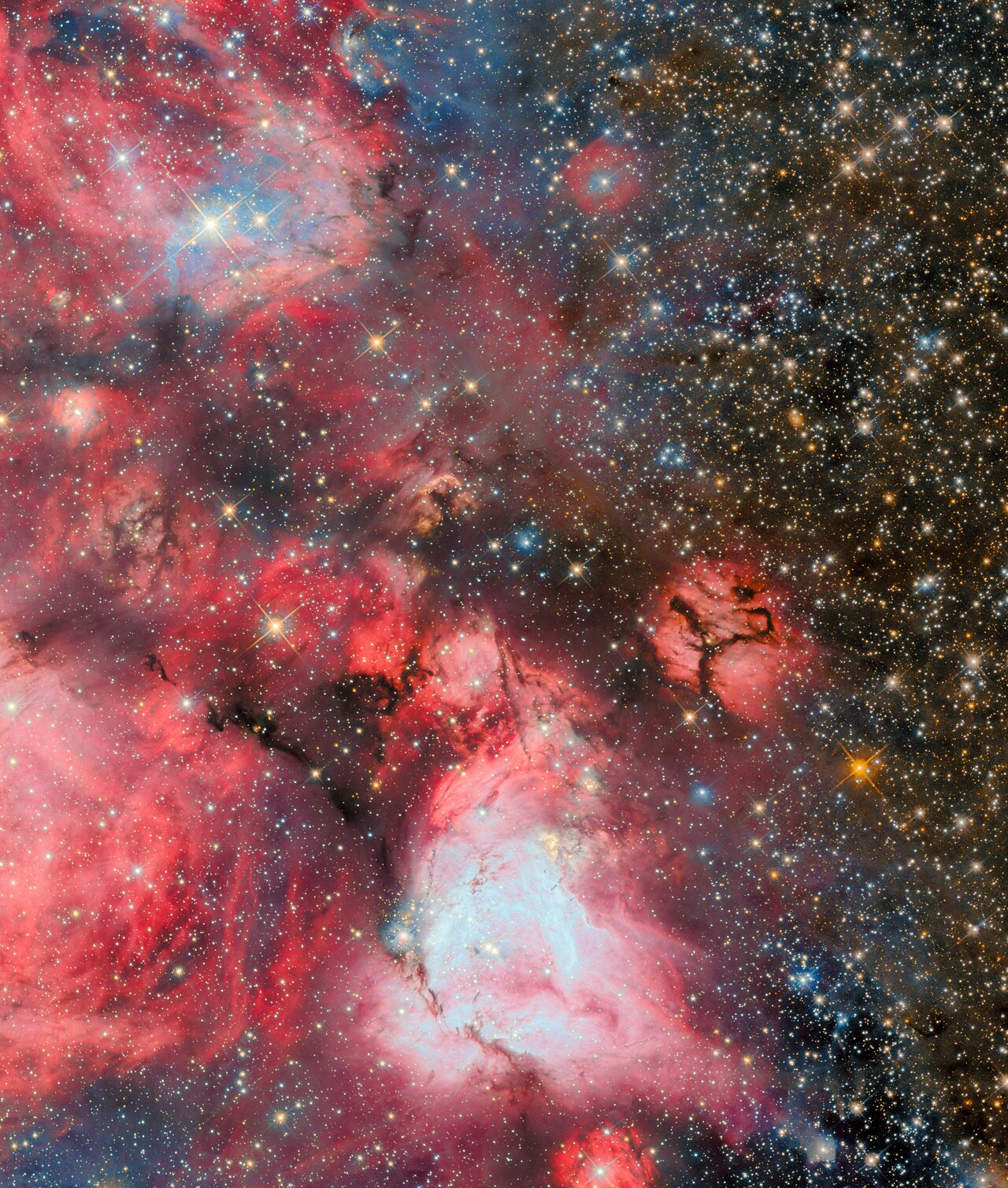
Baby stars blowing bubbles
Where it is in your sky
- Object
- LMC N159
- In the same part of the sky as Large Magellanic Cloud
- Constellation
- Dorado
- Distance
- 160000 light years
- Field of view
- 2.7′ (the full Moon is 31′)
- Best seen
- Evenings from October to February; highest at midnight in December
- Climbs above 20°
- From the South Pole to the equator
- Never rises
- North of 20° N
- What you need
- Beyond backyard telescopes — this is a Webb/Hubble-class target
- Large Magellanic Cloud itself: naked eye, from a dark site
Tonight from your location
From the source
Today’s ESA/Hubble Picture of the Week brings a distant stellar birthplace into focus. This gigantic cloud of cold hydrogen gas is called N159, and it’s located about 160 000 light-years away in the constellation Dorado. N159 is one of the most massive star-forming clouds in the Large Magellanic Cloud, a dwarf galaxy that is the largest of the small galaxies that orbit the Milky Way.
This image shows just a portion of the N159 star-forming complex. The entire complex stretches over 150 light-years across. To put that into perspective, 150 light-years is nearly 10 million times the distance between Earth and the Sun!
In the subzero interior of this gas cloud, subjected to the crushing pressure of gravity, young stars begin to gleam in the darkness. Particularly hot and high-mass stars illuminate their birthplaces with red light. This red glow is characteristic of excited hydrogen atoms, to which Hubble is exquisitely sensitive.
Though some of the bright stars in the cloud appear to be blanketed with reddish gas, others seem to lie at the centre of a reddish bubble, through which the dark backdrop of space is visible. These bubbles are evidence of stellar feedback, in which young stars fry their habitats with high-energy radiation and blow bubbles with their intense stellar winds.
A previous Hubble image of the full N159 star-forming cloud was released in 2016. This version incorporates an additional wavelength of light to highlight the hot gas that surrounds newborn stars.
From ESA/Hubble Picture of the Month. ESA/Hubble & NASA, R. Indebetouw, CC BY 4.0; links removed.


